- Cape Town luxury property (R10m+) grew roughly 8% in 2025; the Western Cape took 40% of all R10m+ residential sales nationally in 2024.
- The semigration cohort — relocating from Johannesburg, London, Sydney — is the dominant premium-furniture buyer, and they buy differently to holiday-home buyers.
- With the rand 30–35% weaker against the euro since 2019, the local-vs-import equation now favours local by 20–35% on like-for-like construction quality.
- Handcraft is winning not on sentiment but on customisation, lead time, repairability and full 20-year cost of ownership.
The South African luxury furniture market has undergone a profound transformation over the past three years. What was once a marketplace dominated by imported European pieces — Italian sofas with 14-week lead times, Scandinavian minimalism at premium prices — has evolved into a more nuanced landscape where local handcraft, rand dynamics, and the search for provenance have fundamentally reshuffled buyer priorities.
This shift isn’t sentimental nostalgia for “made in South Africa.” It is economic rationality meeting cultural appetite. Premium buyers in Cape Town, Johannesburg, and the Atlantic Seaboard are discovering that the value proposition for locally crafted luxury furniture — particularly handmade sofas and bespoke seating — now rivals, and in many cases exceeds, that of imported alternatives.
Who is buying luxury furniture in South Africa today?
The semigration investor
Since 2020, Cape Town has experienced sustained migration from Johannesburg, London, and Sydney. These are high-net-worth individuals purchasing second homes or relocating permanently. They are not price-sensitive but they are design-conscious. They want pieces that signal taste, stability, and permanence. The Atlantic Seaboard, Southern Suburbs and the Winelands are the typical settlement corridors, and the data supports the story: the Western Cape took 40% of all R10m+ residential sales nationally in 2024, and five Cape Town suburbs alone produced R3.6 billion in R20m+ transactions.
The short-term rental investor
A secondary but growing cohort invests in Cape Town properties specifically for short-term rental. These buyers want durable, beautiful furniture that can withstand frequent turnover while commanding premium nightly rates. Handcrafted pieces that photograph well and last ten-plus years align directly with this economics.
The work-from-home upgrader
Five years of remote-work normalisation has made the home itself a business asset. High-income professionals — particularly in finance, tech, and consulting — are spending more on residential furniture than ever before. Quality matters: cheap sofas appear on Zoom calls.
The design specifier
Interior designers and architects working on high-end residential represent perhaps a quarter of the premium furniture market. They are gatekeepers of taste and durability standards. Their recommendations carry enormous weight.
The market landscape
South Africa’s premium furniture segment (pieces above roughly R25,000) represents a meaningful slice of a total furniture market estimated in the mid-twenties of billions of rand annually. Luxury seating — the sofas, daybeds, occasional chairs that anchor a living space — is the highest-value category within that segment.
Handcrafted and locally manufactured premium furniture still accounts for a minority of the premium segment by value. The remainder is imported, primarily from Europe (Italy, Denmark, Germany) and increasingly from Portugal and Spain. But the mix has moved meaningfully toward local over the last three years.
The average price point for a handcrafted locally-made luxury sofa ranges from R35,000 to R85,000. Imported equivalents with comparable specifications often fall between R45,000 and R120,000 once shipping, duties, and currency conversion are factored in.
“A R50,000 handcrafted sofa that lasts 25 years costs R2,000 per year. A R70,000 imported sofa that degrades within 12 years costs R5,833 per year.”
Why 2026 is different: the economics of import vs. local
The rand factor
The South African rand has weakened approximately 30–35% against the euro since 2019. A sofa that cost R50,000 at 2019 euro prices now costs around R66,500 if priced identically in foreign currency. The psychological and practical appeal of “R35,000 locally made” versus “R55,000 imported” is immense.
Import duties and lead times
Importing upholstered furniture from Europe incurs duties of 12–18% depending on material composition and origin. Add shipping (15–25% of product cost), insurance, and customs clearance, and you are looking at 40–50% of base product cost in ancillary expenses. A R40,000 ex-factory Danish piece becomes a R60,000–R65,000 proposition by the time it arrives in Cape Town. Most European furniture ships 12–16 weeks from purchase; a locally made handcrafted sofa typically ships in 6–8.
The customisation premium
Imported furniture offers limited customisation. Local handcraft studios operate on a build-to-order model. Buyers specify fabric, colour, dimension, leg style, and cushion composition. This flexibility appeals directly to designers and affluent homeowners who refuse cookie-cutter aesthetics.
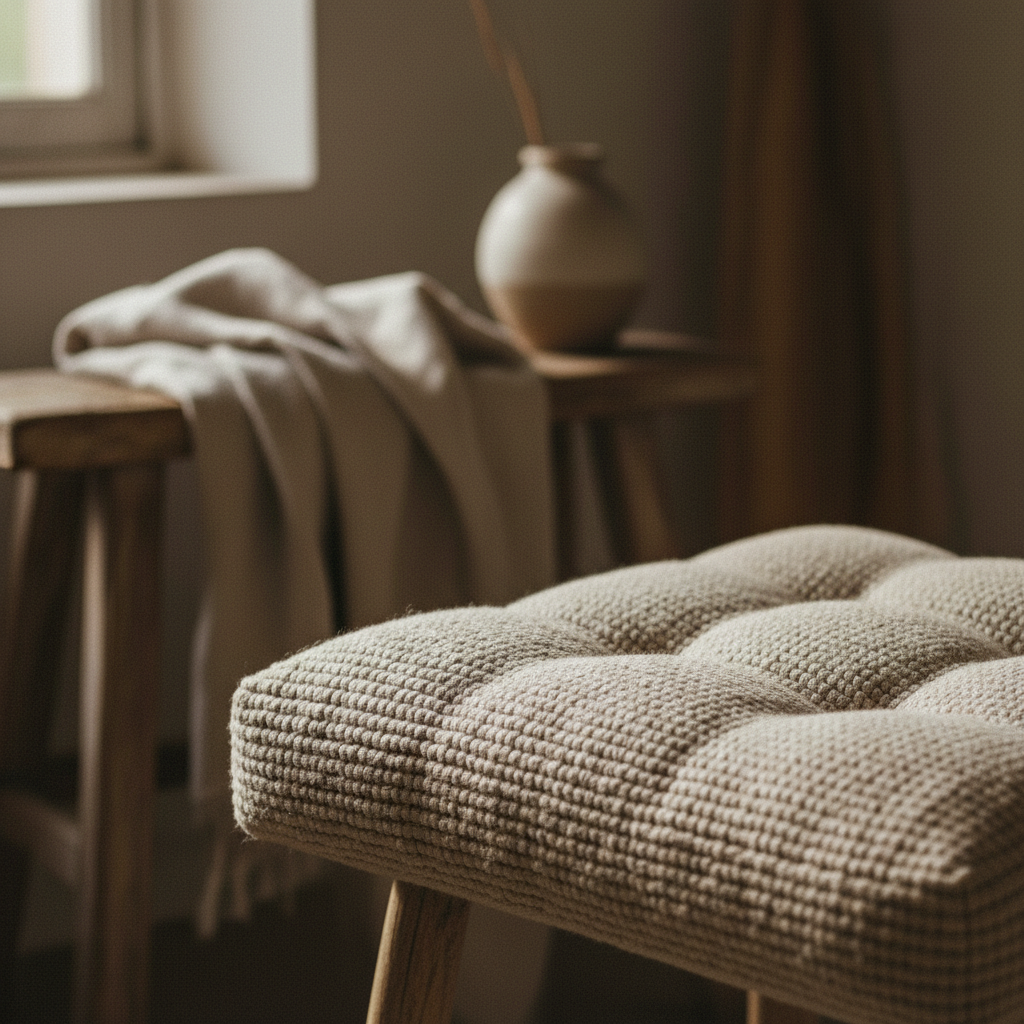
What premium buyers actually want in 2026
1. Provenance and brand story
Premium buyers want to know: who made this, what is the craft story, and how long will it last? A sofa from a Cape Town workshop with 30+ years of craft heritage commands emotional resonance. It is a story you can tell guests. It is heritage.
2. Sustainability and material honesty
The premium buyer in 2026 is acutely aware of fast furniture’s environmental footprint. They want pieces that will last 15–30 years: solid wood frames (not MDF), natural fillings (latex, wool, high-density foam), repairable construction, and transparent supply chains.
3. Customisation without compromise
The ability to specify fabric, colour, dimensions, and construction details is not peripheral — it is central to the purchase decision. Designers working on high-end residential need bespoke solutions.
4. Longevity over trend
The price point (R35,000+) signals intent to keep the piece for decades. Premium buyers want timeless design: clean lines, quality proportions, materials that improve with age.
5. Reasonable lead times and after-sales support
A 6–8 week lead time on locally-made pieces versus 14 weeks for imports is a material advantage. Local makers provide responsive after-sales: repairs, re-upholstery, frame adjustments.
The handcraft advantage: why slow furniture is winning
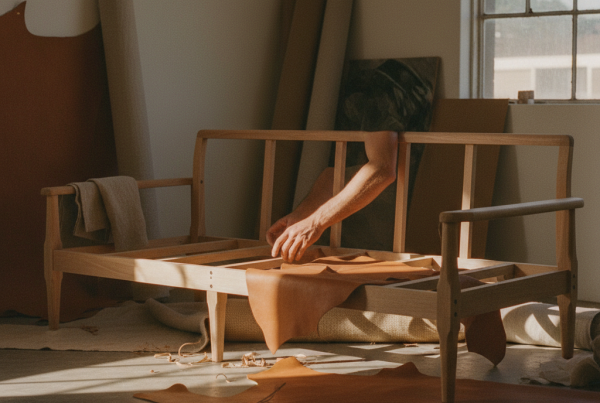
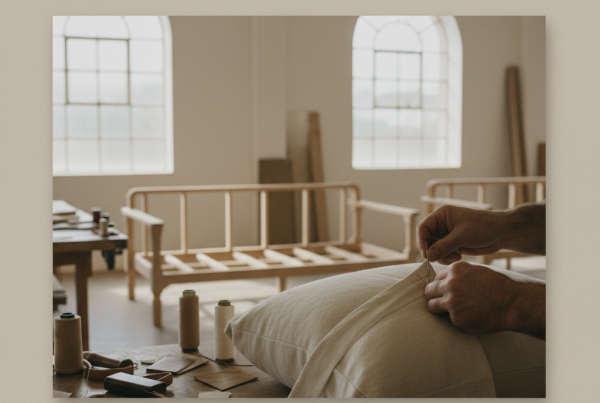
The global “slow furniture” movement has found particular resonance in South Africa’s premium segment. A handcrafted sofa made by artisans who have spent years perfecting their craft will outlast a mass-produced import by a decade or more. Cape Town makers like Loom & Hide — whose Jung and Stratus models have become specifier favourites among Atlantic Seaboard designers — represent this philosophy: build once, maintain forever.
The cost-per-year calculus is compelling: a R50,000 handcrafted sofa that lasts 25 years costs R2,000 per year. An R70,000 imported sofa that degrades within 12 years costs R5,833 per year. The emotional valuation follows the arithmetic.
Visit the showroom that is shaping the market
See the range, feel the construction, discuss a custom brief. The Palms Décor Centre is a short walk from the heart of Woodstock.
Frequently Asked Questions
Why choose locally-made over an imported luxury brand?
Locally-made offers superior customisation, shorter lead times (6–8 weeks vs 12–16), better after-sales support, and comparable or better value when import duties and currency conversion are factored in. The repairability advantage alone often justifies the choice on a 10-year view.
How long will a handcrafted sofa actually last?
A well-made handcrafted sofa with a solid hardwood frame, natural fillings, and traditional joinery will remain functional and beautiful for 20–30 years. Re-upholstery extends that indefinitely, because the frame — the expensive part — keeps on going.
What should I look for when buying premium luxury furniture in SA?
Seek makers with demonstrated craft heritage (10+ years minimum), transparent material sourcing, customisation capability, documented after-sales support, and a physical showroom you can visit. Explore the full Loom & Hide sofa range as a benchmark.
How much has Cape Town luxury property grown?
The Cape Town R10m+ property segment grew approximately 8% in 2025. The Western Cape took 40% of all R10m+ residential sales nationally in 2024, and five Cape Town suburbs alone produced R3.6 billion in R20m+ transactions.
What is the price range for a handcrafted luxury sofa in SA?
R35,000 to R85,000 depending on dimensions, fabric and configuration. Imported equivalents on like-for-like construction typically fall between R45,000 and R120,000 landed.
Who are the buyers driving the premium furniture market?
Four main cohorts: semigration relocators to Cape Town, short-term rental investors, high-income work-from-home professionals, and the design specifier community (interior designers and architects on high-end residential).
- Property24 — Cape Town luxury property market 2025 review
- Cape Argus / DG Properties — Western Cape share of R10m+ residential sales, 2024
- SARB — ZAR/EUR historical exchange data, 2019–2026
- SARS — tariff schedule on upholstered furniture imports (HS 9401)