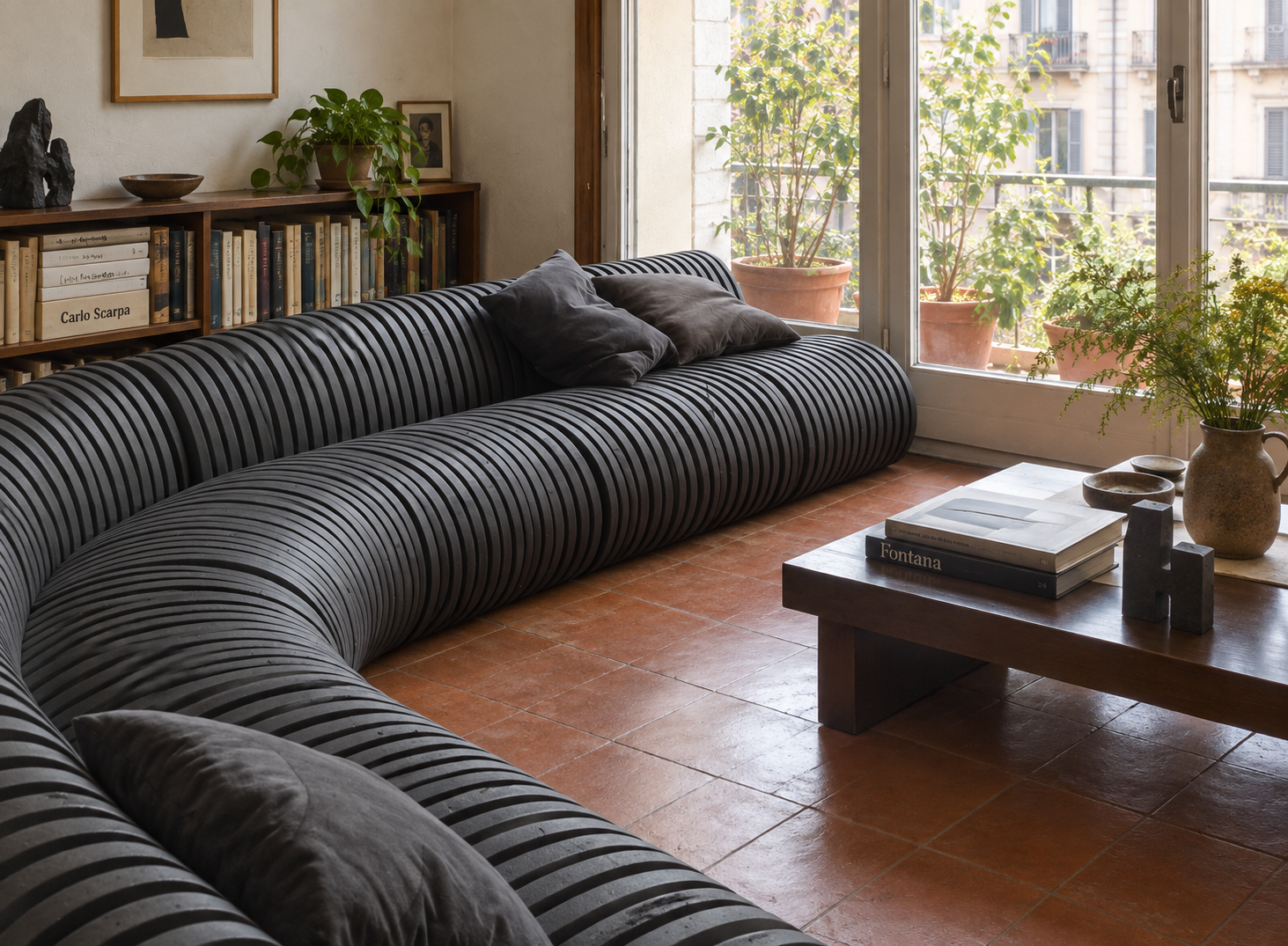
A long ribbed form curves through space. Serpentone proposed that the room could determine the length of the sofa, rather than choose from fixed sizes.
A sofa usually ends before the room does. Two seats, three seats, perhaps another section added at the corner. Cini Boeri’s Serpentone asks a different question: how far should the seating continue?
I like the change in emphasis. The room becomes the measure. The familiar product sizes become less important than the line the furniture will draw through the space.
A length of seating
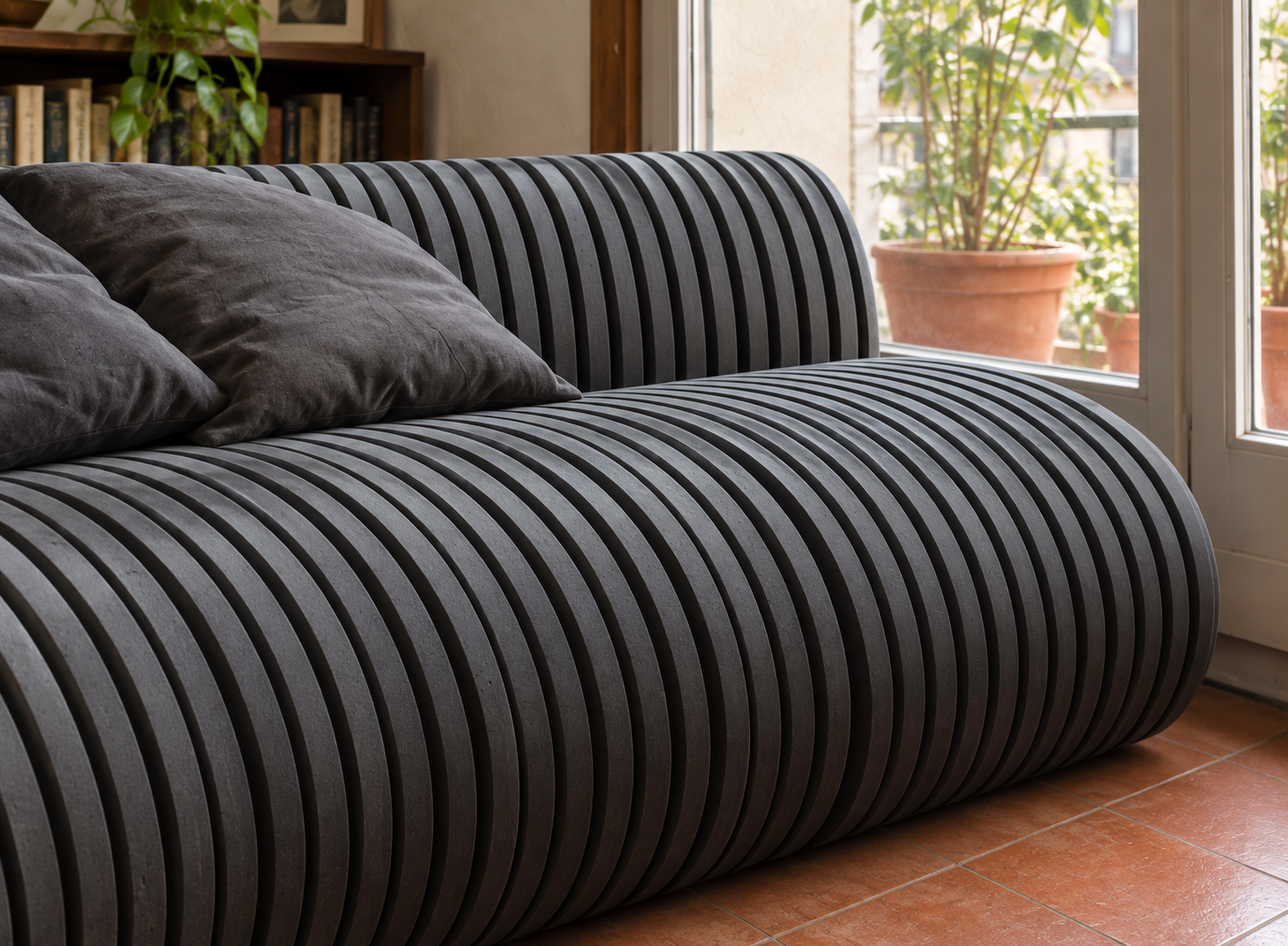
Serpentone is Boeri’s 1971 project for Arflex: a flexible, ribbed polyurethane form conceived to be sold by the metre. Its repeating sections allow the long body to curve rather than remain a straight upholstered block.
The historical distinction matters. Memoria Scolastica, a research resource published with Roma TrE-Press and the Museo della Scuola e dell’Educazione, describes it as a prototype that did not enter production. The proposition was seating to be sold by length; that does not establish a routine retail business in which customers actually ordered it that way.
The idea is still compelling. Fabric arrives by length. So does carpet. Treat a sofa with something of that continuity and it begins to act less like an isolated object and more like a boundary that can be shaped around activity.
The line leaves the wall
A conventional sofa often offers two distinct ends, visual full stops that help contain its place in a room. Serpentone’s repeated ribs pull the eye onwards. The curve becomes the stronger fact.
It can suggest a gathering place without requiring every sitter to face the same direction. Follow the curve and the relationship between people changes along its length. There is a social possibility in that geometry, although the plan still has to provide access and useful places to sit.
The room opens into a courtyard. The line of seating keeps going, bends back on itself, and begins to look like something that has arrived under its own power. The ribs make the turn visible, a long body negotiating the space.
The room becomes the measure.
The prototype and the photograph
An archival photograph documented by Memoria Scolastica shows children gathered around the curving form in a school courtyard. Their presence gives its size and playfulness an immediate reading. They turn an abstract proposition about flexible furniture into a scene of people finding uses for an unfamiliar object.
I find the image more persuasive than a catalogue claim about limitless possibilities. There is a particular shape, in a particular place, with bodies around it. The design has to meet the scale of ordinary activity.
At the same time, the image cannot settle what the project would have cost to order, how it would have been delivered or how well its materials would have aged in a home. Those belong to the practical life a product would need beyond the prototype.
A proposition worth keeping
The useful question Serpentone leaves behind is how much of a sofa’s size needs to be decided before anyone sees the room. Standard modules, made-to-measure construction and continuous seating offer different answers. Boeri’s project makes that choice unusually visible.
Its value for me is in the proposal itself: let the seating take its measure from the space and let the space remain open to change. The project can still ask that question, even where its commercial history remains uncertain.
At the far end of the courtyard, the line turns again. The sofa has not run out of room yet.
Continue through the archive: Camaleonda.
A Loom & Hide design-archive story.
Find your place to sit.
Explore Loom & Hide’s sofas, handcrafted in Woodstock, Cape Town.

