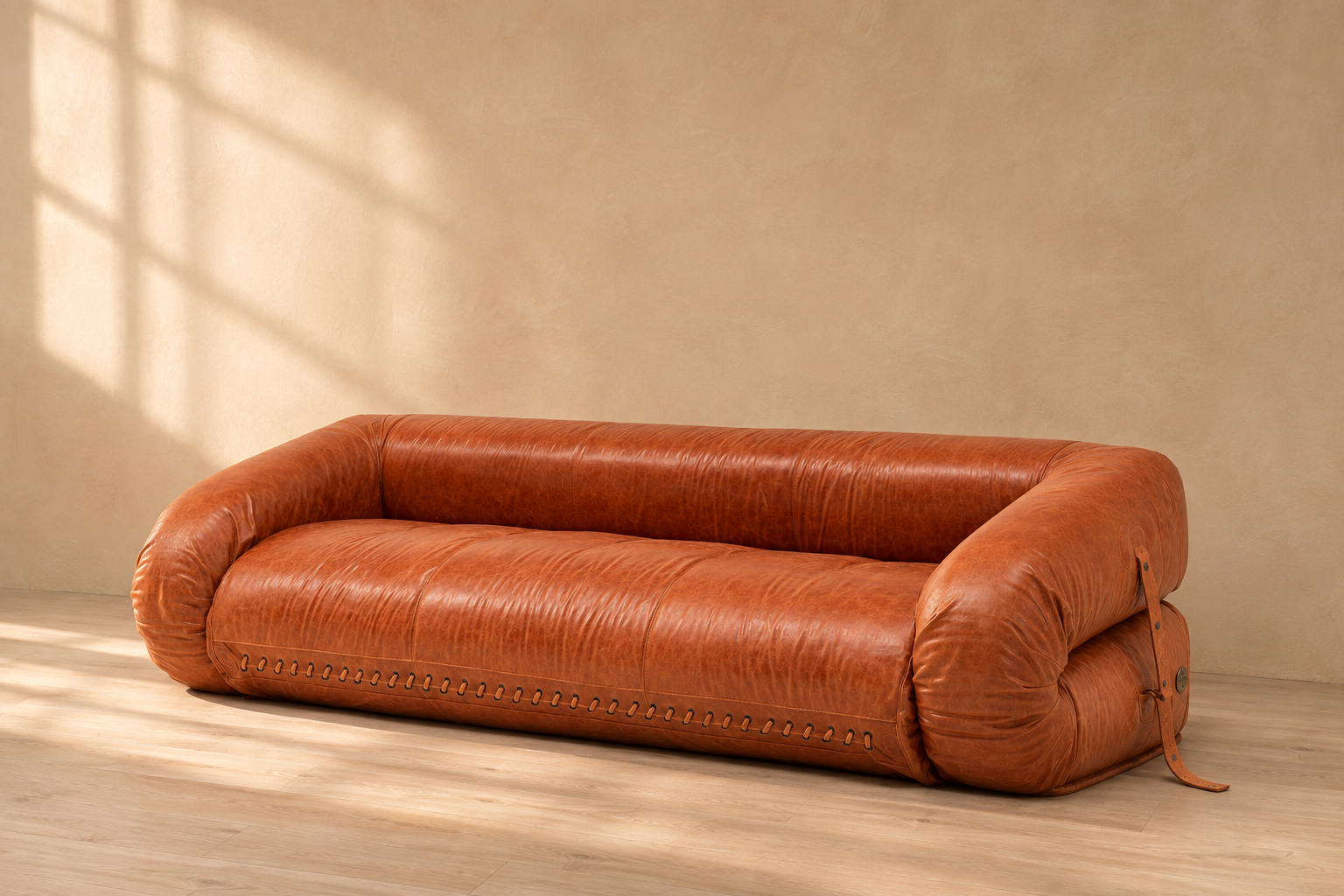
Alessandro Becchi’s folding sofa bed keeps finding me through Instagram. Its appeal is in the change of shape as much as the shape itself.
Anfibio has filled my Instagram feed too many times for me to let it slip past this archive. Some furniture becomes familiar through the room it occupies. This one keeps arriving through a screen, recognisable before I have finished scrolling.
Its closed shape is only half the attraction. The sofa has another arrangement waiting inside it, and that makes the next image almost irresistible. What has changed? Where has the seat gone? How much floor has it claimed this time?
The upholstered room unfolds
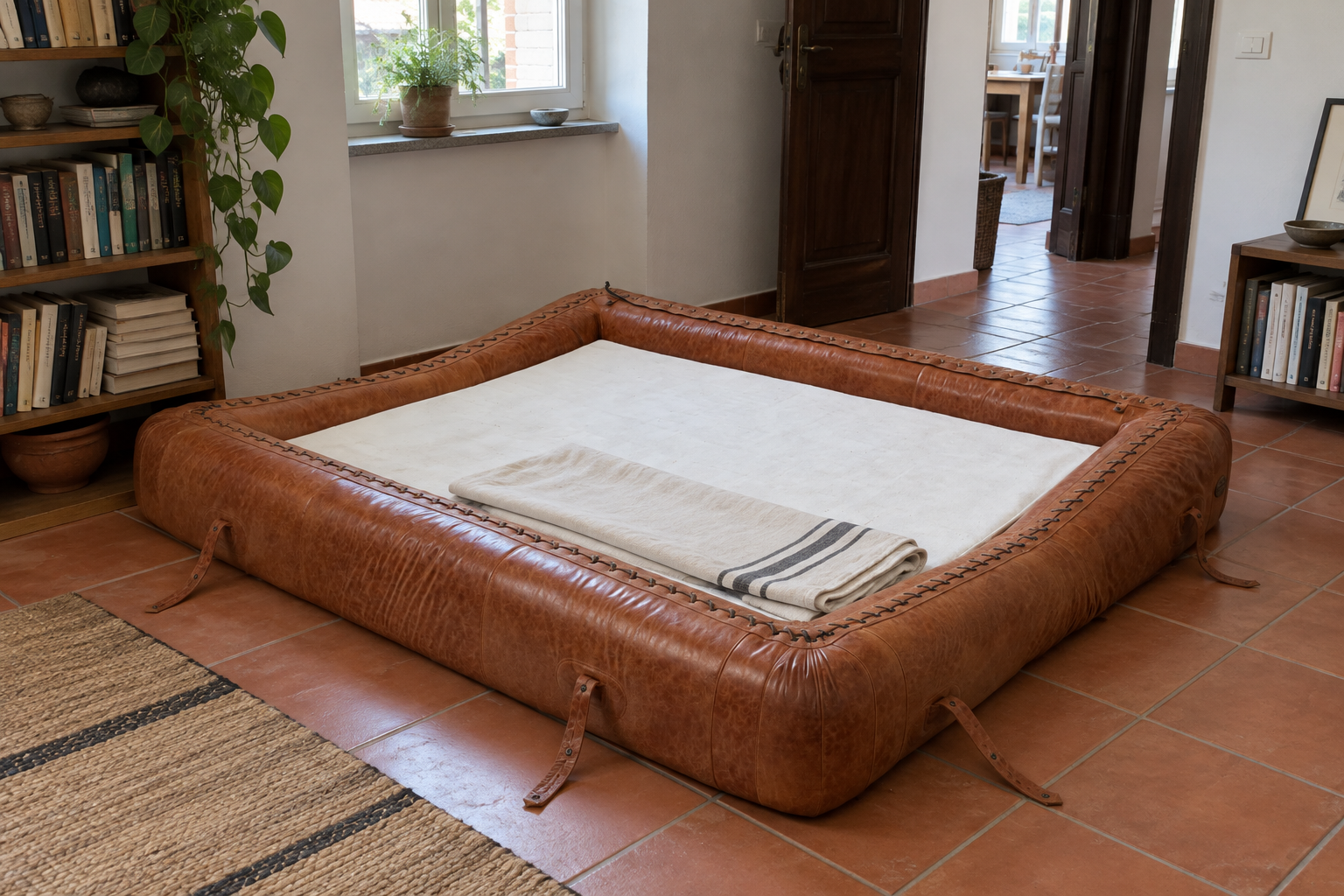
Giovannetti dates Alessandro Becchi’s design to 1970. Its current presentation shows sofa, bed, relax and atoll configurations. In the sofa arrangement, the rolled upholstered boundary encloses the seat. Open it and the sleeping surface extends outwards, changing the relationship between the centre and the perimeter.
The low form seems to spill into the room. A place for sitting becomes a place for lying down; the floor around it becomes part of the composition. The name Anfibio, amphibian, suits an object that belongs comfortably to more than one category.
The photographs make this transition unusually legible. You can compare the same upholstered roll in several positions. The shape does not disappear into a concealed metal bed; its transformation remains visible.
There is structure beneath the softness
That visual softness can mislead. Giovannetti’s current specification includes a rectangular steel-profile structure supporting the rolled section, polyurethane padding, and a polyurethane mattress. The covered parts are removable. It is not accurately described as a completely frameless heap of foam.
That matters to the story because the achievement is in arranging structure and softness so that the change appears natural. Calling it a sofa with nothing rigid inside would make the engineering vanish just when it becomes interesting.
A vintage example needs to be understood on its own terms. Its covering, filling and fastenings may differ from the current specification. The age of the design does not tell us which materials are in the piece being photographed or offered for sale.
Its closed shape is only half the attraction.
The floor is part of the purchase
The practical question I would begin with is space. A sofa bed has to work in both arrangements, which means the room must make sense after it opens. The coffee table, the route to the door and the place where someone gets up all become part of that decision.
Anfibio makes the question visible. Its broad open form asks for a clear area rather than hiding the extent of the bed behind an ordinary sofa profile. I find that appealing as design, although a compelling sequence of photographs cannot decide whether the low sleeping position suits a particular person.
It also asks how often the room changes roles. Occasional visitors, a studio used in different ways, or a home where the living space becomes a bedroom place different demands on the same object. There is no need to declare every other sofa bed a failure to recognise the intelligence of Becchi’s approach.
From one screen to the next
What interests me is how well an old proposition travels through a new medium. The feed gives us short encounters with objects, and a change of state can hold attention in a way that a static outline cannot. Anfibio has a second answer ready when the first photograph seems familiar.
The next room opens out of the last. The seat lowers, the boundary moves, and the floor begins to look like somewhere to stay. Then the screen changes again. Anfibio will be back; it has already made itself difficult to forget.
Continue through the archive: Camaleonda.
A Loom & Hide design-archive story.
Find your place to sit.
Explore Loom & Hide’s sofas, handcrafted in Woodstock, Cape Town.

