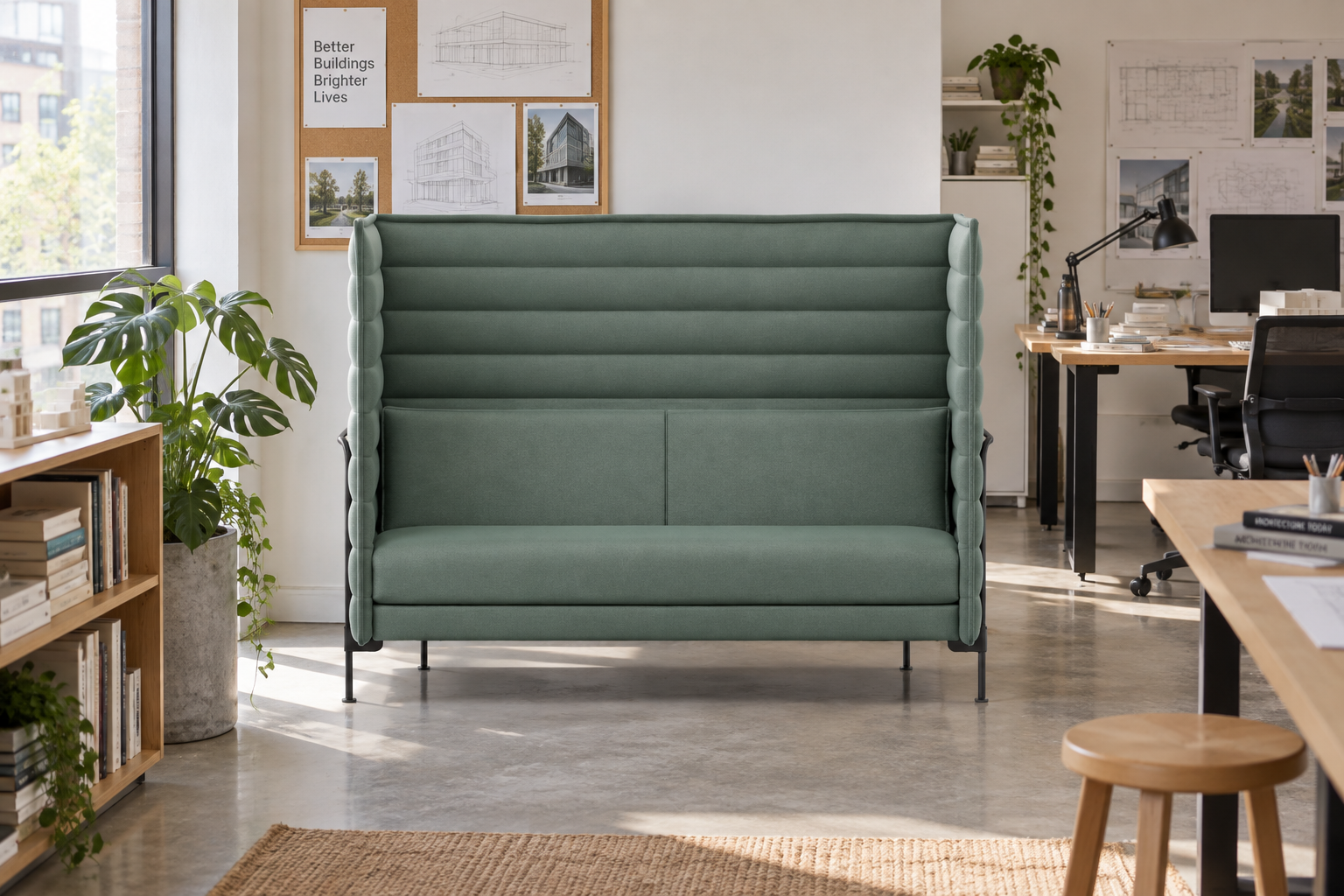
That is what the Alcove makes me think of: Le Corbusier asked to design an office cubicle. The Bouroullecs gave the sofa walls of its own.
If Le Corbusier had to design an office cubicle, I suspect it might look something like this. The Alcove has that amusing uncertainty about whether you are looking at furniture or a small piece of a building.
It is Ronan and Erwan Bouroullec’s design for Vitra, of course. The Le Corbusier comparison is the joke it puts in my head: a sofa with architectural ambitions, quietly taking possession of the office floor.
A room arrives with the sofa
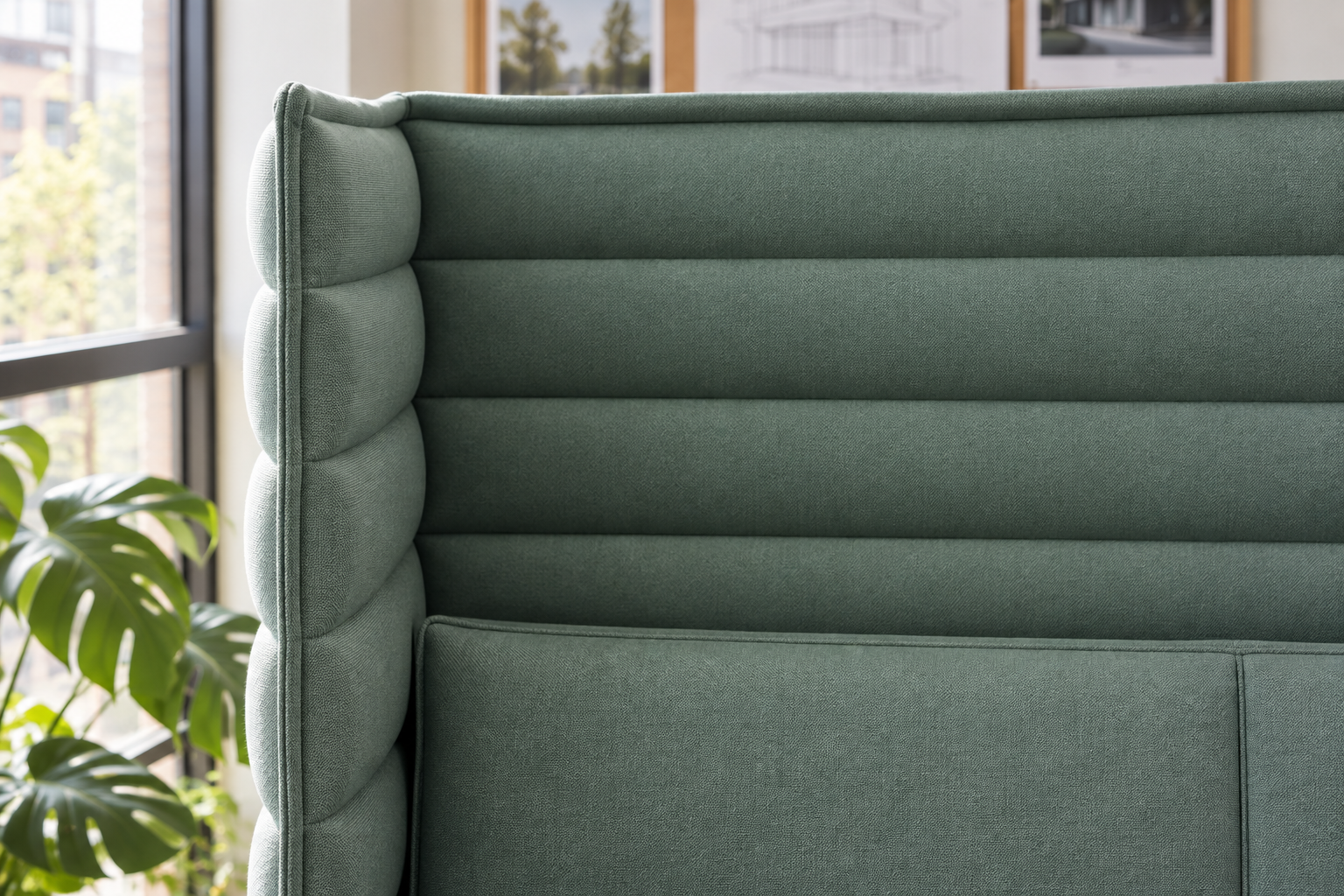
Vitra dates the Alcove family to 2006, with a later update in 2021. The Highback version raises padded side and back panels around the seating. The manufacturer describes these as providing visual and acoustic shelter, particularly when two sofas face each other.
I like the modesty of the move. The sofa does not need to become a complete room. Three sides are enough to change how the space reads. Across an open floor, a little enclosure appears; the building’s walls can remain where they were.
The plan draws itself around the furniture. Two seats face each other and a conversation acquires an address. Turn one away and the same floor begins to offer somewhere to withdraw. It is a small change in the drawing, with a much larger effect on the character of the space.
How much enclosure?
There is more than one Alcove. Vitra’s range includes lower panels as well as the Highback, and different upholstery options for lounging and work. Those distinctions matter more than treating every photograph as the same tall booth.
The lower sofa lets the eye travel over it. The Highback interrupts that journey. I find the second more interesting in an open setting, where it can give shape to an otherwise undifferentiated area. In a small room already divided by walls, the additional enclosure may be less welcome.
The panels do not make a soundproof meeting room. Acoustic shelter and confidential speech are different requirements. A sofa can help soften an environment without doing everything a properly enclosed room does.
A sofa with architectural ambitions, quietly taking possession of the office floor.
The cubicle comes home
At home, I would be interested in the tension between shelter and sociability. A tall back can create a place to read within a larger room, but it also changes the view from everywhere else. You gain an interior within the interior; somebody standing on the other side gets a wall of upholstery.
That is a decision for the plan, not a reason to dismiss the sofa. Look at where people enter, what they see first, and which direction the seats face. A piece this architectural asks to be placed deliberately. A pair can make a strong enclosure, but a single sofa is not an incomplete purchase.
I would also keep the versions distinct when choosing one. Vitra lists removable covers and different seat constructions for its Lounge and Work upholstery. The apparent simplicity of the upholstered box conceals practical choices about how it will be used.
The boundary is the interesting part
The Alcove earns its place here because it makes the edge of a sofa worth thinking about. Usually we attend to the seat: its depth, its cushions, what supports us. Here the material beside and behind the sitter becomes the larger proposition.
A wall belongs to the building until someone upholsters it and gives it legs. Then we call it a sofa, move it across the floor, and discover that the room has moved with it.
Continue through the archive: Togo and Camaleonda.
A Loom & Hide design-archive story.
Find your place to sit.
Explore Loom & Hide’s sofas, handcrafted in Woodstock, Cape Town.

