Mario Bellini’s Bibambola makes a whole sofa look like a cushion. The trick has survived since 1972, even as the construction has changed.
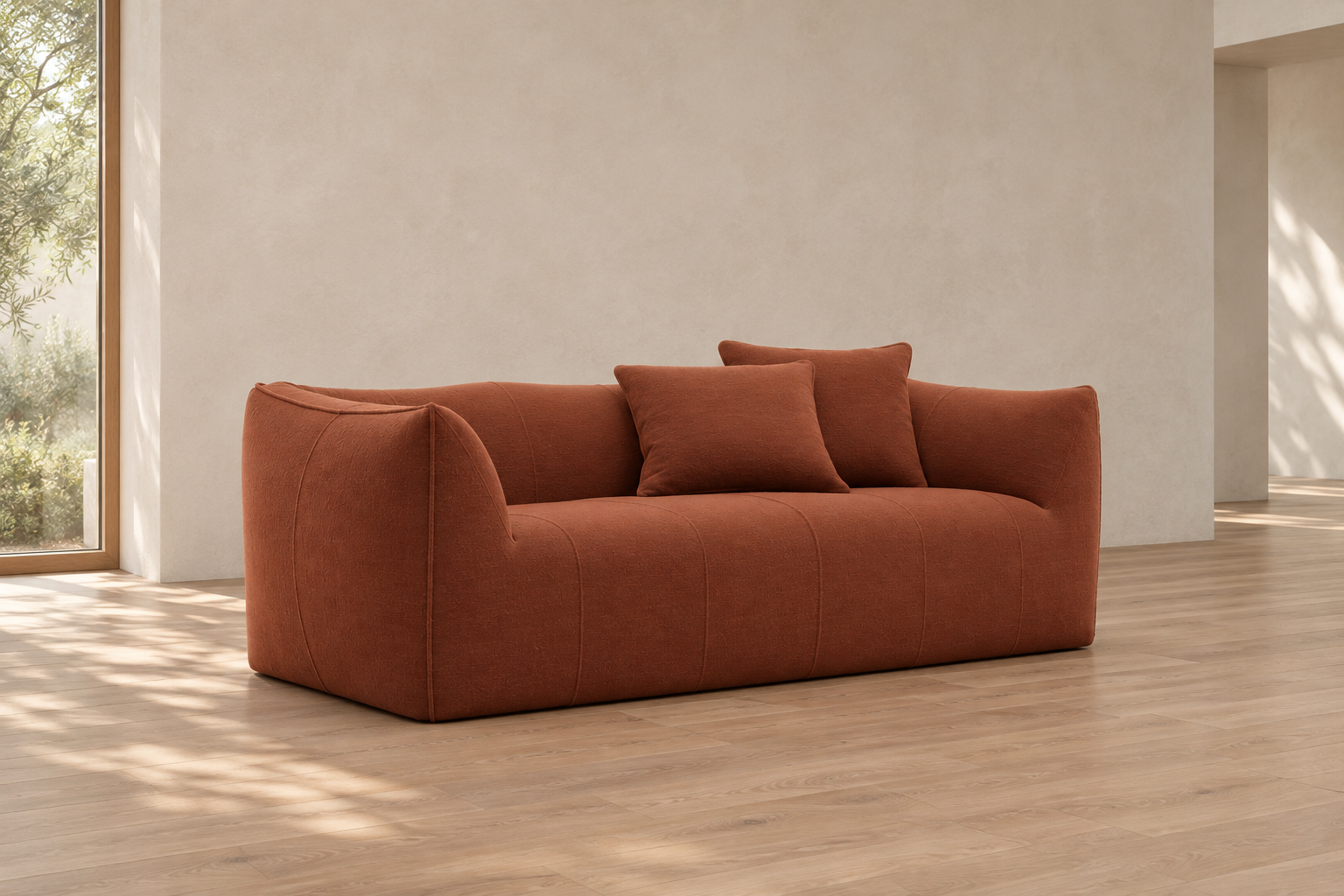
The most appealing thing about Bibambola is the bit that looks slightly out of control. Its corners swell. The seat pushes forward. The back seems to have settled into the arms, as though the whole sofa has been persuaded into shape by someone squeezing it from either end.
It has enough definition to be recognisable and enough looseness to avoid looking prim. That balance is harder than it appears. An ordinary sofa with overfilled cushions tends to look like an ordinary sofa with overfilled cushions. Here the cushion has taken over the job of describing the object.
A family with several names
Mario Bellini designed Le Bambole in 1972 for C&B Italia. His archive records the collection’s Compasso d’Oro award in 1979. Le Bambole is the family name: Bambola is the armchair, while Bibambola is the sofa for two. The larger Granbambola joined the family in 2022. It is easy to let those names blur together, particularly when a photograph arrives without a caption.
The distinction is worth keeping because scale changes the character. The compact Bibambola has a particularly satisfying density. There is very little visual breathing room between one rounded part and the next. Instead of displaying a neat arrangement of separate cushions, it offers a single, slightly unruly presence.
Look at the outer corners and the softness becomes more convincing. They do not finish with the crisp upright line of a conventional arm. They roll away. The eye follows that curve around the side, then returns to the crease where the seat meets the back. Those few movements do an extraordinary amount of work.
The skeleton is still there
B&B Italia describes the original construction as a metal structure embedded in polyurethane. For the 2022 version, the company introduced a structure using recycled polyethylene and components designed for disassembly. The outline carries an older idea forward through a different construction.
That makes the apparent lack of a frame more interesting. The sofa has support; it simply declines to show it off. There are no exposed rails asking to be admired, no timber legs explaining how the weight gets to the floor. The engineering stays behind the upholstery.
And that restraint changes how the object meets the room. A framed sofa offers a clear division between the furniture and its padding. Bibambola makes the padding seem to be the furniture. Its visual weight sits low, where the rounded base touches the ground, while the upper edges look comparatively pliable.
The corners are doing more work than the straight lines.
Leave the cushions alone
There is a temptation to decorate a sofa this distinctive until it becomes harmless. Add enough small scatter cushions and suddenly the large shape has a collection of smaller shapes interrupting it. Bibambola rewards a little restraint. The curves already provide the movement that extra accessories are often brought in to supply.
This is an observation about the composition, rather than a rule for somebody else’s home. A blanket can be useful. A favourite cushion can matter more than a photograph. Still, it is worth seeing what Bellini has done before covering it up. The seat, back and ends have a relationship of their own.
The room around it need not imitate the sofa. Straight shelving, a plain wall or a table with a clear edge can give those rounded volumes something to work against. Put curves everywhere and the particularity starts to disappear. Give this one a little space and the shape becomes legible again.
What survives the anniversary
A reissue creates an awkward question for any design archive: which object are we admiring? The historical piece, with its original materials and accumulated wear, or the current version that carries the same name into another home? In this case the answer needs to stay specific. The 1972 design and the 2022 construction belong to the same story, but they are different moments in it.
There is no need to turn that difference into a contest. The older sofa records the choices of its period. The newer one shows which parts the designer and manufacturer considered worth retaining and which could change. The swollen corners and the continuity between seat and back remain the recognisable gesture.
Bibambola has lasted because that gesture is unusually complete. Even stripped of an elaborate setting, it gives the eye plenty to enjoy. A broad seat, a generous back, a curve that refuses to end in a sharp corner. Sometimes the furniture story is right there in the silhouette.
Continue through the archive: Camaleonda.
A Loom & Hide design archive story. We write about these pieces for the love of the ideas; we do not make replicas or copies of protected original designs.

