Eighteen upholstered discs floating on a steel frame: a sofa that arrived a decade early, sold barely a few hundred examples, and was designed by a man whose name was left off it for forty years.

The Marshmallow sofa began with a salesman carrying a plastic disc into an office, and it is worth pausing on how strange that is.
The story, as told by the people who were there, goes like this. In the mid 1950s an inventor turned up at George Nelson Associates, the New York studio that directed design for Herman Miller, with a self-skinning plastic disc that could be manufactured cheaply by the thousand. Sofas were expensive precisely because upholstery was continuous, hand-built, labour-hungry. But what if a sofa were not continuous at all? What if it were simply an array of identical cushions, stamped out like records? Irving Harper, the studio’s quietly brilliant designer, already the author of Herman Miller’s logo and the famous Ball clock, took the idea home and worked it into a sofa over a weekend, drawing it on his own time because the studio billed by the job. Eighteen round cushions, arranged in a shifted grid on a skeletal steel frame, deliberately not touching, each one reading as a separate dot of colour. The plastic discs themselves failed testing and were abandoned, so the production cushions were conventionally upholstered after all. The economy vanished; the idea remained.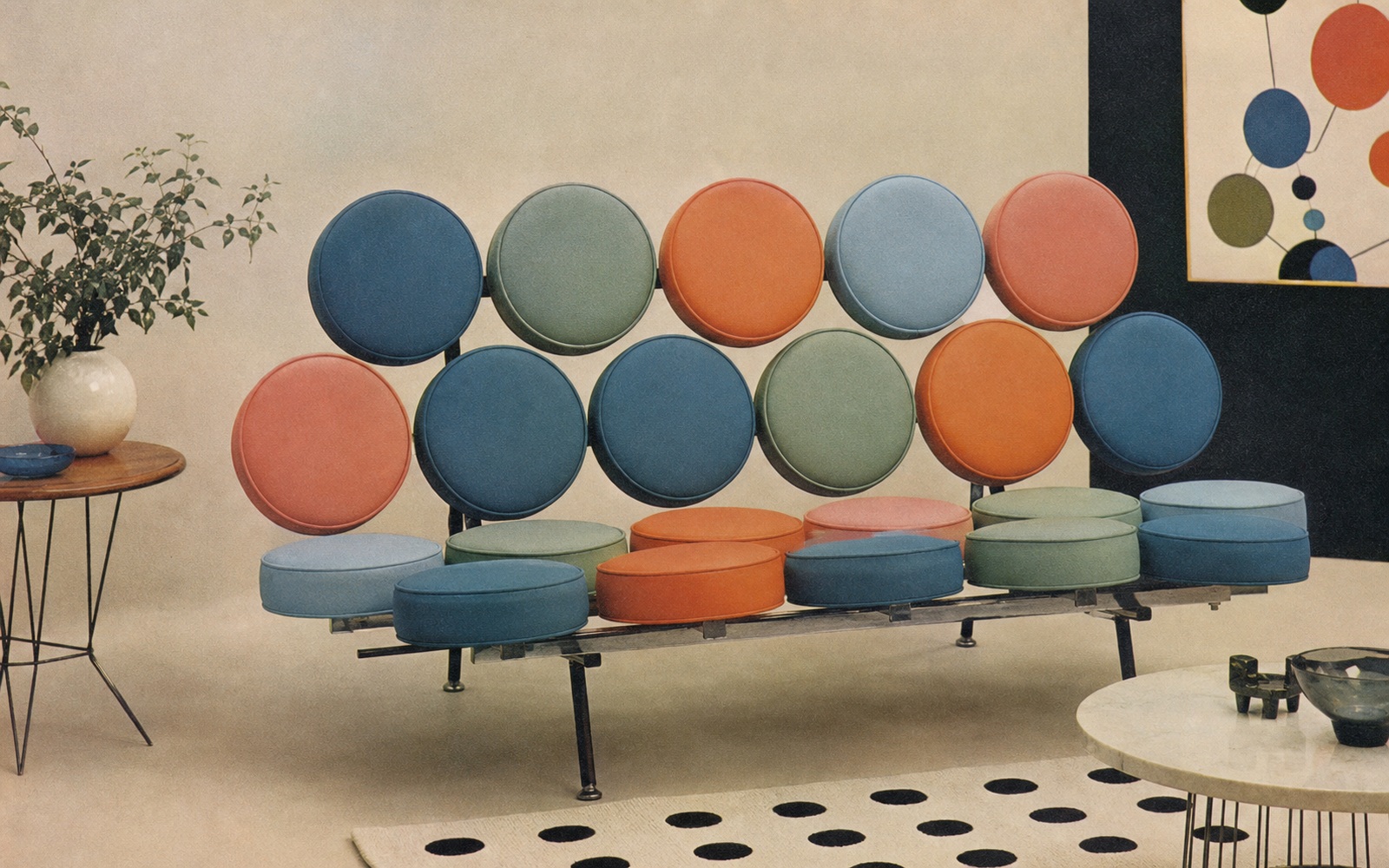
A sofa made of pixels
Look at what that idea actually was, because it was radical twice over. First, structurally: the Marshmallow abandons the single upholstered body that had defined the sofa for three centuries, replacing mass with an array. You can see straight through it. It is a sofa drawn as a diagram of a sofa. Second, graphically: because every cushion is a disc, the sofa is effectively a painting in circles, and in its multicolour versions it stops being furniture and becomes pop art you can sit on, years before pop art had a name. The eye reads it the way it reads a halftone print or, to a modern eye, pixels. Nothing else in the American living room of 1956 looked remotely like it. The Eames lounge chair, launched the same year by the same manufacturer, perfected the existing idea of comfort; the Marshmallow questioned whether a sofa needed a body at all. One became an instant bestseller. The other was quietly discontinued around 1961 after only a few hundred were made, a number that has made surviving originals auction-room treasure.“It is a sofa drawn as a diagram of a sofa.”

The name on the label
For decades the sofa was credited simply to George Nelson, whose name the studio carried. Harper, who designed it, stayed silent with a professional’s discipline; that was how design offices worked, and Nelson’s name was the brand. Only late in Harper’s long life did the record get corrected, and Herman Miller itself now tells the story plainly: the Marshmallow sofa was designed by Irving Harper. It is one of design history’s tidiest lessons in reading the fine print, and it rhymes with stories we have told elsewhere in this archive, from Lilly Reich’s pavilion to Charlotte Perriand’s chaise: the object got famous; the hand that drew it waited.The honest knock
Let us be honest about the sitting. The Marshmallow is firm, upright and social; the discs support you at eighteen specific points, and no one has ever sunk into it, because there is nothing to sink into. It is a two-hour sofa, not a Sunday sofa. It is also fragile in the way graphic objects are: one sagging or faded disc breaks the whole grid, like a dead pixel. And its price as an original or licensed reissue is serious. It earns its keep as an idea and an image more than as a nest, and buyers should know which of those they are shopping for.Copies, and the tell


Sources
- Marshmallow sofa, 1956, Irving Harper authorship within George Nelson Associates, Herman Miller. hermanmiller.com
- The self-skinning plastic disc origin story and the discs’ failure in testing. Reported in the linked source; as recounted in interviews with Irving Harper and Herman Miller’s own histories. wikipedia.org
- Limited original production run before discontinuation around 1961. Probable; figures in the low hundreds are widely cited, exact counts vary by source. wikipedia.org
- Irving Harper, career, the Herman Miller logo and Ball clock. wikipedia.org

