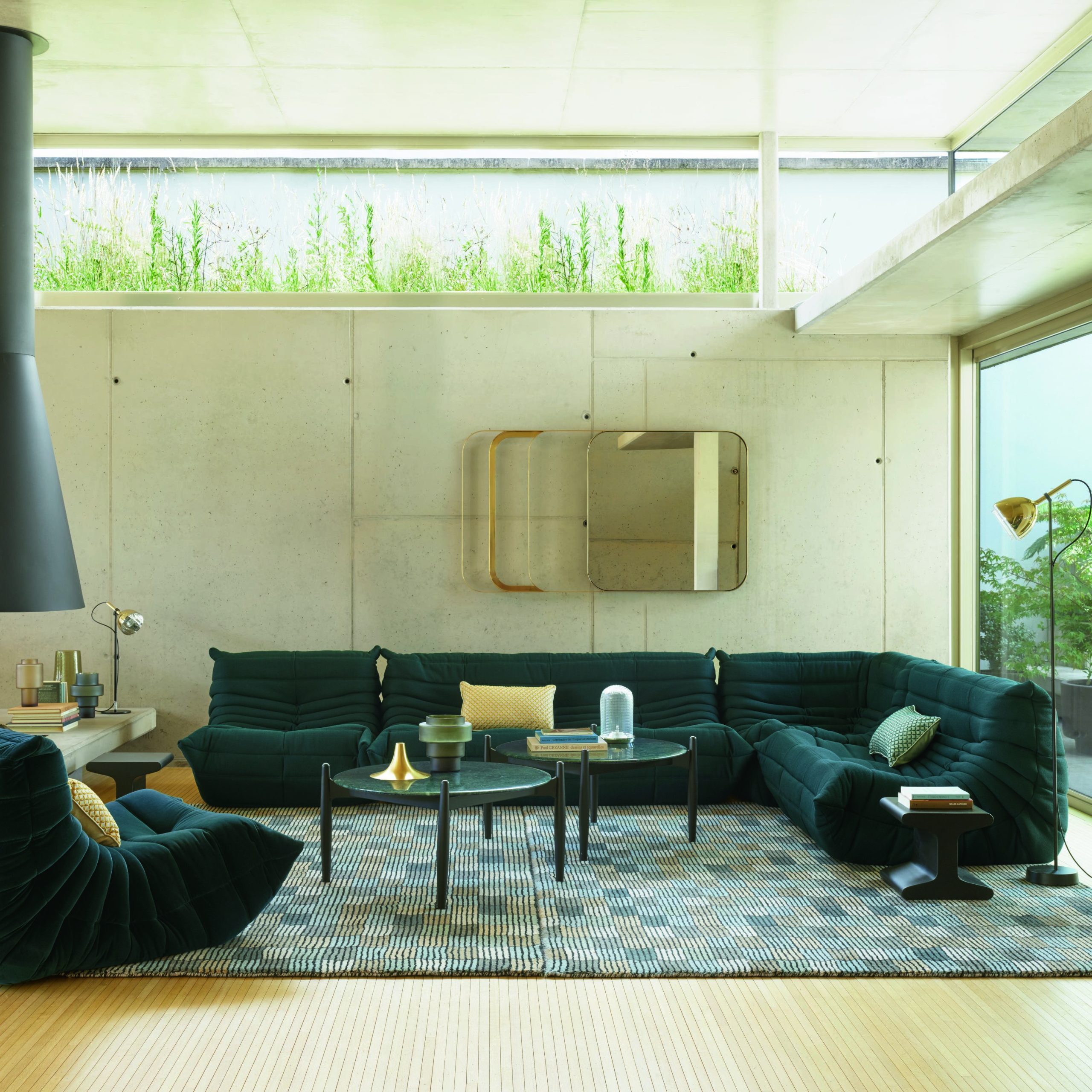
Both sofas can be rearranged. The difference is what changes within each piece, and what keeps its shape.
Togo and Camaleonda both let an owner compose a room. What interests me is the different kind of freedom each gives them.
Two kinds of component
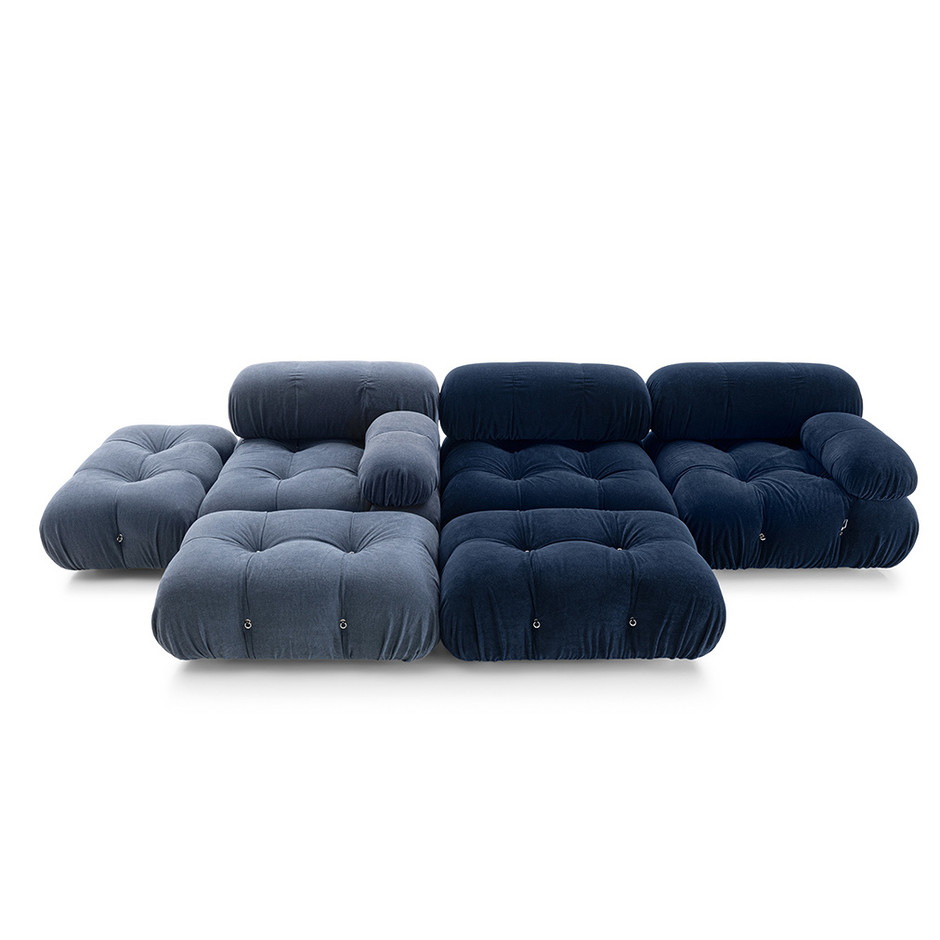
The Camaleonda was designed by Mario Bellini in 1970. Michel Ducaroy's Togo followed in 1973. Their soft, low forms invite comparison, but describing one as modular and the other as fixed misses something important.
Ligne Roset sells Togo as a collection, including settees, a fireside chair and a corner seat. You can arrange those pieces together and move them apart. There is no need to buy another piece merely to rearrange the ones you already own.
Camaleonda offers a further kind of change. B&B Italia describes modules whose relationships can be altered through detachable connections. Its current presentation includes moving backs and arms to change an arrangement. A Togo corner seat remains a corner-shaped seat when moved; Camaleonda makes more of the component itself available for recomposition.
That is a useful distinction. Both give you pieces to arrange. One makes the identity of those pieces more adjustable.
What the eye sees
I read the Camaleonda as a field of squares. The repetitions make the system visible, even before the connections are explained. A run of it can divide a room; a looser arrangement can become a group of separate seats. It does not need a wall to justify itself.
The Togo has a more continuous profile within each piece. Its folds soften the divisions, and the low outline gives it a settled, almost deposited appearance. Put several together and you still have an arrangement, but the eye is occupied by the upholstery as much as by the plan.
I prefer the Togo's visual looseness in a room that already has strong architectural lines. I can also see the pleasure of using Camaleonda's repetition to bring order to a more open space. Those are preferences about composition, not rules about where either sofa will work.
What can change later
There are several different reasons to want flexibility. A move to another house. A different household. More guests. Or simply the wish to sit somewhere else. A sofa does not have to be rearranged every week for its adaptability to be useful.
The question I would ask is which future change the system actually allows. Moving whole seats is one answer. Repositioning backs and arms is another. Adding compatible elements years later is another again, and depends on availability as well as design.
A photograph of an arrangement cannot answer all of that. A plan, a demonstration and an explanation of the components can. The extra explanation is part of selling a system; it is not proof that a system cannot be sold.
Under the softness
The constructions also need to be kept distinct. Ligne Roset describes Togo's all-foam construction. The current Camaleonda, reissued in 2020, has wooden panels and layered polyurethane padding. B&B Italia says the interior was redesigned for that edition. It should not be described as an identical frameless counterpart to Togo, or treated as a specification for every vintage example.
That difference matters when assessing an old piece. With either sofa, the condition of its covering, filling and any connections needs examination. Recovering sound foam and rebuilding deteriorated foam are different jobs. A frame, where there is one, also needs inspection. Neither name settles the repair question on its own.
Which freedom matters?
What I do have is a preference for furniture whose freedoms are easy to understand. Show me what moves, what stays the same and what I might need to buy later. Camaleonda makes a larger invitation to alter its composition. Togo offers recognisable forms that can be grouped and regrouped. I can imagine wanting either, for different rooms and different lives.
Continue through the archive: Togo and Camaleonda.
A Loom & Hide design-archive story.
Find your place to sit.
Explore Loom & Hide’s sofas, handcrafted in Woodstock, Cape Town.

