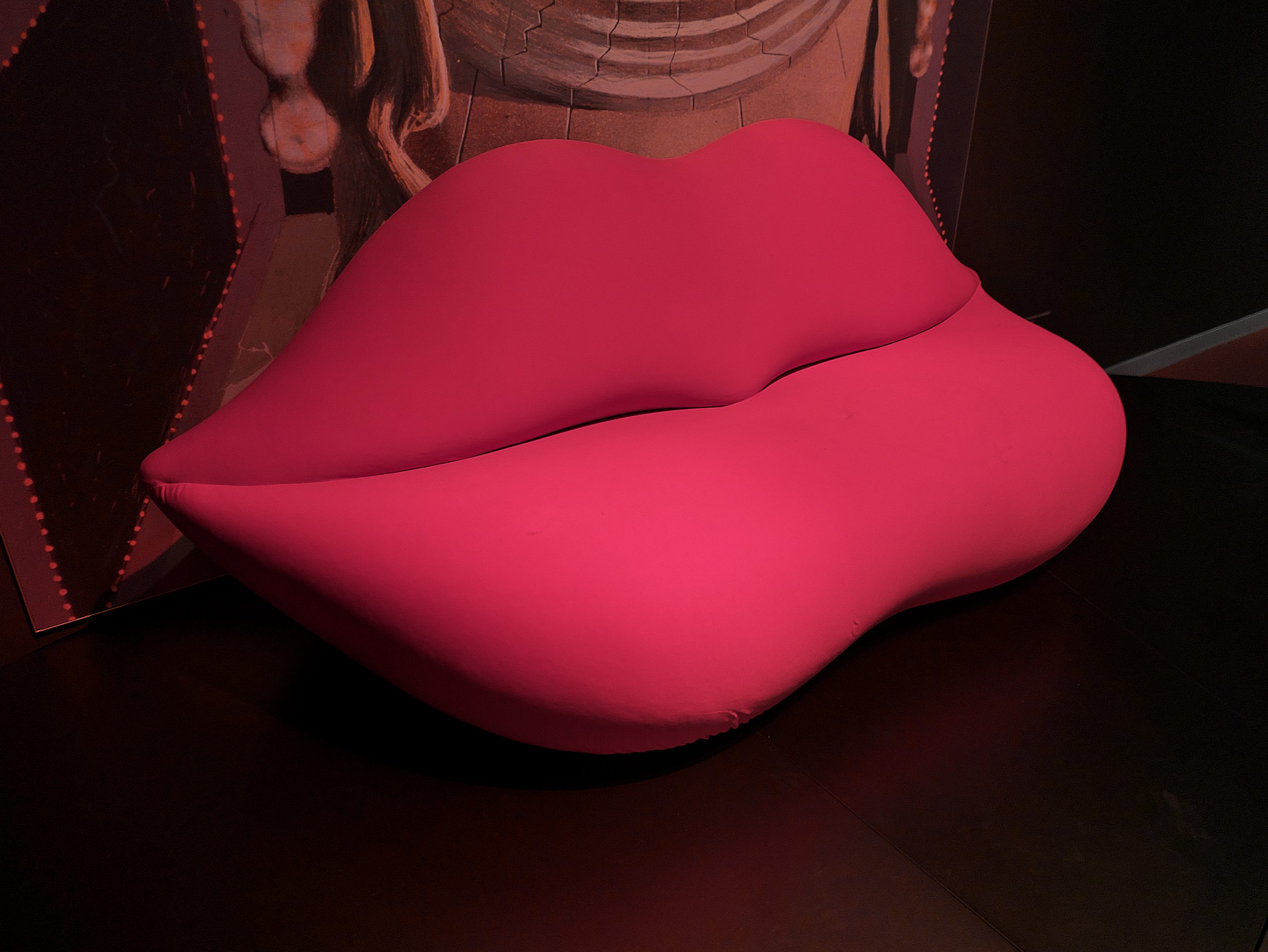
I tried to recreate the Bocca while studying furniture design. Weeks later, the result was more Rocky Horror than Italian lips.
I have a confession about the Bocca. While I was studying, I tried to recreate it in my dad’s workshop. The curves and edging haunted me. I spent weeks trying to build out those lips while keeping the frame. What I ended up with was more Rocky Horror than Bocca.
There is a particular humiliation in discovering that a shape you can recognise instantly is one you cannot persuade into existence. Two lips. How much trouble could two lips possibly be?
Enough to occupy weeks in a workshop, apparently.
A mouth without a face
The Bocca is almost too easy to remember. The lower lip offers the seat; the upper one rises behind it. Between them, a dark line gives the mouth its expression. Remove the rest of the face and the expression survives. Enlarge it to the width of a sofa and the room acquires a character it did not invite.
This is what I like about it. The shape is extravagant, but the idea is economical. It needs very little to make itself understood.
A curtain falls across the doorway. The room beyond begins to look back at us. Its fireplace becomes a nose; the pictures on the wall become eyes. At the centre sits a mouth, waiting for somebody to mistake it for furniture.
In Salvador Dalí’s 1935 image of Mae West, that exchange between a face and a room becomes the whole composition. Museo Omero identifies it as an inspiration for Studio 65’s later sofa. Bocca belongs to 1970 and to Studio 65 and Gufram; it is a later design with its own life, rather than another name for Dalí’s original lips sofa.
The drawing meets the workshop
Knowing the reference does not make the curve any easier to build. The trouble I remember was precisely there: the curves, the edging, the effort of holding the shape together. A mouth has to remain a mouth when it gains depth. It has to survive the turn around the side.
In a photograph the outline arrives complete. You meet it after the difficult decisions have disappeared into the object. Trying to recreate it sends you back through those decisions, including the ones you did not know were decisions until they went wrong.
Gufram’s technical sheet describes the Bocca as soft polyurethane with a removable fabric covering. The material has to carry that rounded form, and the cover has to follow it without losing the mouth’s expression.
What I ended up with was more Rocky Horror than Bocca.
I would keep that failure in the story. It is more revealing than a tidy paragraph about appreciating an icon. I liked the sofa enough to attempt it, and the attempt made the apparently simple outline much less simple.
Living with the joke
The harder question is what happens after the first laugh. Bocca will always be a mouth in the room. Put a solemn painting above it and it may look as though it is about to answer back. Build an entire room around its theatricality and the furniture can start competing for the last word.
I prefer it with some space around it. Let the lips do the talking. The temptation to add another joke, another bright object, another knowing reference seems to me the quickest way to exhaust the first one.
That is a visual preference. The seat itself deserves its own encounter; my weeks making a version do not amount to sitting in Gufram’s. What they do give me is a lasting respect for that edge, the small turn where a convincing mouth can become something rather more alarming.
Back in my dad’s workshop, the lips have gone a little wrong again. They are still recognisable. They simply appear to be expecting a different sort of evening.
Continue through the archive: Togo and Camaleonda.
A Loom & Hide design-archive story.
Find your place to sit.
Explore Loom & Hide’s sofas, handcrafted in Woodstock, Cape Town.

