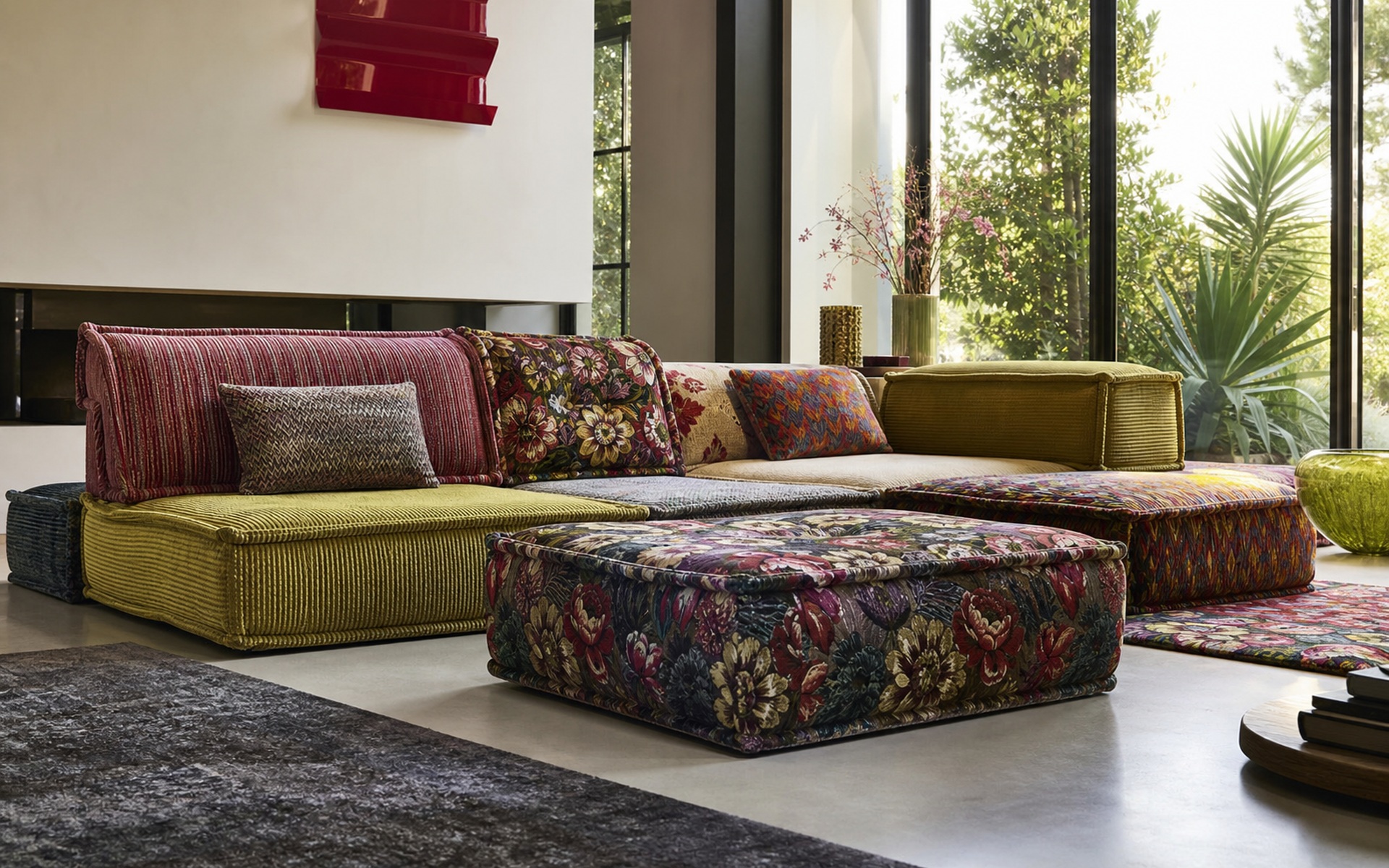
Three simple cushions, stackable like the tiles of the game that named it, quietly declared that the floor was furniture too. Fashion houses have been dressing the result for more than fifty years.
The Mah Jong sofa has no frame, no legs, no back and, strictly speaking, no fixed shape. What it has instead is a rule.
The rule is this: three low upholstered elements, a flat base cushion, a seat and an angled back wedge, all built on the same modular footprint, all stackable and re-arrangeable like the tiles of the Chinese game it is named after. From that one rule a household can deal itself a low sofa, a chaise, a daybed, an island, a whole padded landscape across the floor, and re-deal it next weekend. Hans Hopfer designed it in 1971 for Roche Bobois, the Paris furniture house, and it belongs body and soul to that moment. The rigid, legged sofa was under attack from every direction: Ducaroy’s Togo would soon slump gloriously to the carpet in France, Italy was unbolting the sofa into movable blocks like the Camaleonda, and a generation that sat cross-legged on floors at concerts and in ashrams saw no reason to climb back up onto its parents’ upholstery. Hopfer’s genius was to take that floor-dwelling instinct and give it a system.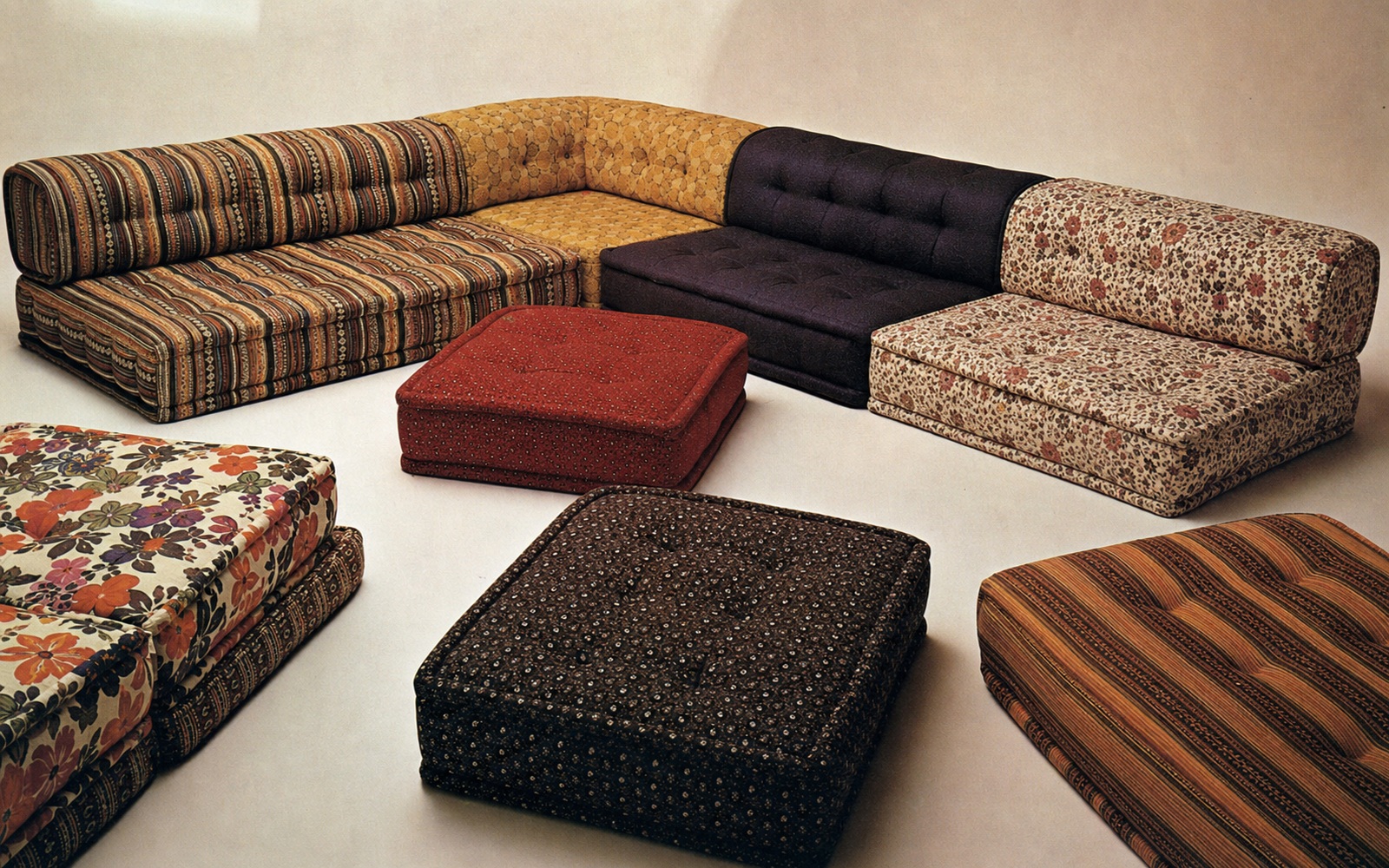
The sofa as a game you keep playing
Most modular seating of the era was architectural: big blocks, serious reconfiguration, furniture you rearranged twice a year with a friend’s help. The Mah Jong is playful in the literal sense. The elements are light enough to be tossed, the combinations are endless, and the object never insists on a final form. Children instinctively understand it as a fort kit. Adults, given a week, come around to the children’s view. That refusal of a fixed form turned out to be commercially brilliant, because it made the Mah Jong a canvas. Roche Bobois has spent decades inviting fashion houses to dress it, most famously Missoni Home, whose zigzag knits made the sofa a magazine fixture, with couture editions by Kenzo Takada and Jean Paul Gaultier following. The furniture stays the same three shapes; the wardrobe changes with the seasons. No other sofa in this archive moonlights as a runway.“Children instinctively understand it as a fort kit. Adults, given a week, come around to the children’s view.”
How to see it

The honest knock
Concede the obvious: the Mah Jong lives at floor level, and so must you. Guests with proud knees will perch on a double stack and quietly long for an armrest, of which there are none. The system’s freedom is also a chore, since elements wander, covers need straightening, and a Mah Jong room left unattended for a week looks less like a landscape than a laundry. Dressed in couture fabrics it carries a couture price for what is, structurally, a very sophisticated pile of cushions. And it is a poor fit for households that want a sofa to hold one dignified shape forever. It will not. Holding shapes is not its game.Copies, and the tell
Floor cushions being ancient and unprotectable in general, the market teems with “Mah Jong style” sets, and the shortfalls repeat. Copies get the footprint wrong, so elements never stack flush and the landscape drifts apart in use. The internal build is the big one: authentic elements hold their loft and square edges for decades, where cheap fills pancake within a year, and a flat Mah Jong is just bedding. The quilting goes sparse or machine-flat, the tailored covers become baggy slipcovers, and pattern-matching across seams, the quiet signature of the real thing, disappears entirely. The original is upholstery pretending to be casual. The copy is casual, full stop. More than fifty years on, half the “floor lounging” content on the internet is unknowingly quoting Hopfer’s three tiles. The game, it turns out, had staying power: deal, sit, re-deal.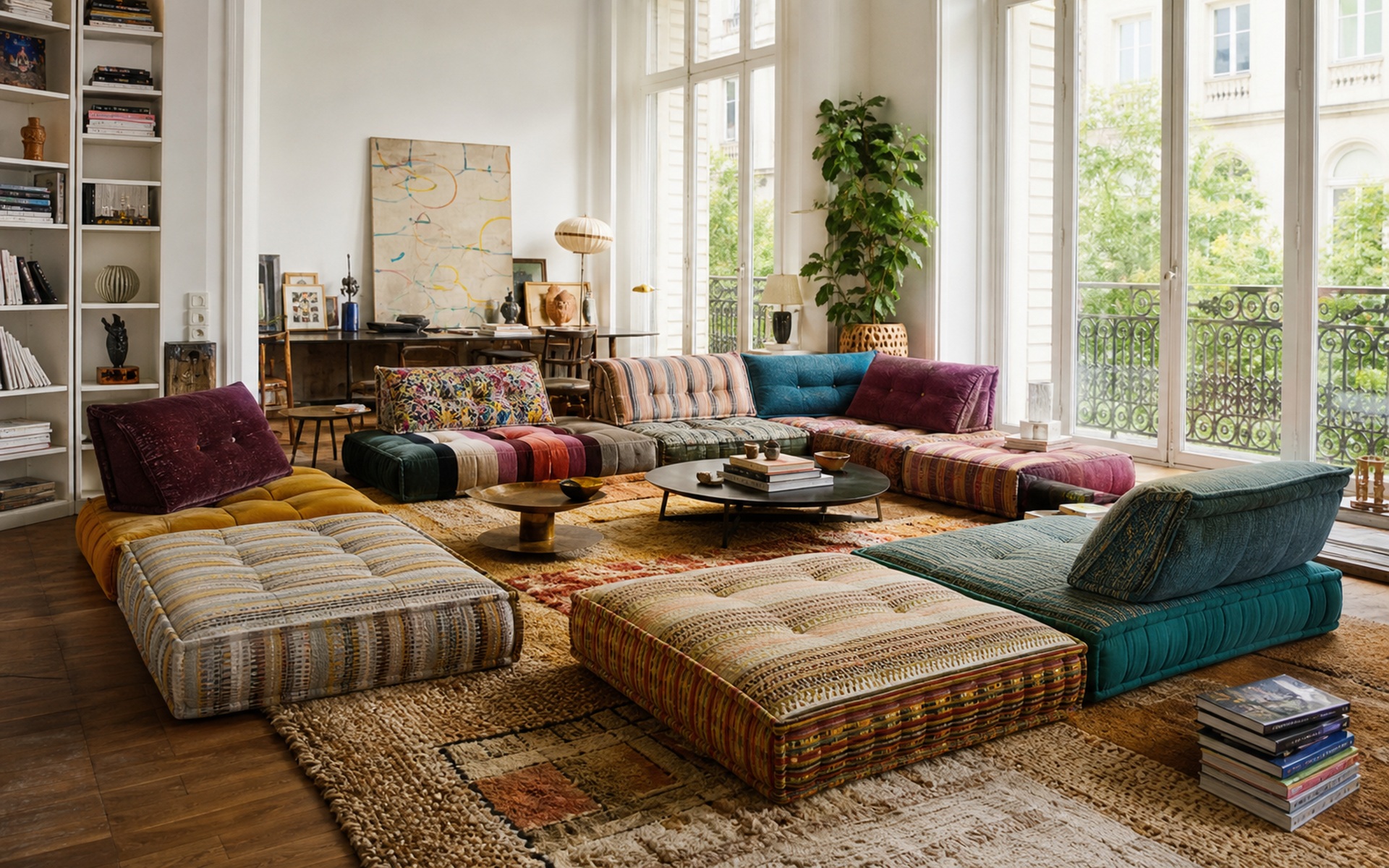
Sources
- Mah Jong sofa, Hans Hopfer, 1971, modular concept and history, Roche Bobois. roche-bobois.com
- Couture editions with Missoni Home, Kenzo Takada and Jean Paul Gaultier. Verified via Roche Bobois collections and design press. roche-bobois.com
- Roche Bobois company history. wikipedia.org

