It was designed as a throne for a king who, as far as history records, never sat down. It became the seat of every boardroom that wanted to look like it ruled something.

Barcelona, May 1929. The International Exposition is opening on Montjuic hill, and Germany, ten years out of a catastrophic war, has one pavilion in which to show the world it has become a different country.
What it builds is barely a building at all. The German Pavilion by Ludwig Mies van der Rohe is a low horizontal plane of travertine, green marble and golden onyx, walls that slide past each other without ever quite making rooms, water, glass, silence. There is almost nothing in it. And that was the problem that produced the chair: King Alfonso XIII of Spain was to visit the pavilion for the official ceremony, and an empty masterpiece still needs somewhere for a king to sit. So Mies, working with Lilly Reich, the designer and longtime collaborator whose name history spent decades forgetting, designed what he privately understood as a modern throne. Two chromed steel bars scissor past each other in a single sprung curve, and two leather cushions, hand-welted and buttoned, rest on leather straps between them. It is monumental and weightless at once. The story goes that the king never actually sat in it during the ceremony, which may be the most fitting detail of all. The Barcelona chair has always been more about presence than sitting.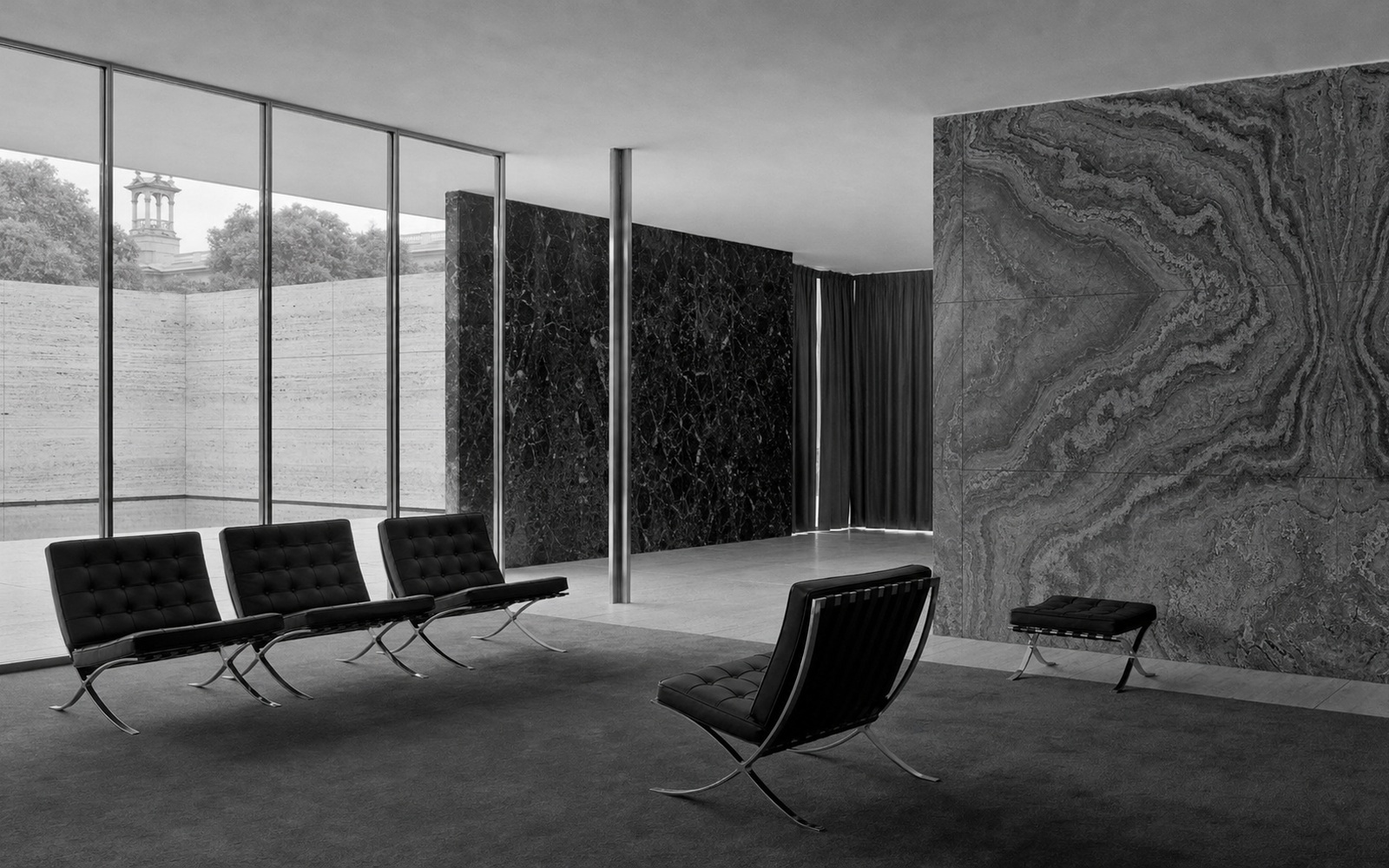
A throne without a kingdom
The pavilion itself was demolished in 1930 when the exposition closed, an astonishing thought now, and for decades the most influential building of the century existed only in photographs. The chair survived it. Mies brought the design to America when he emigrated, and from 1948 Knoll put it into production, where it has remained ever since, its frame refined in 1950 into a single seamless piece of stainless steel, polished like jewellery. Then something rare happened: the building came back. Barcelona rebuilt the pavilion on its original site in 1986, working from photographs and surviving drawings, and you can stand in it today, on the travertine, beside the onyx wall, with the chairs positioned where the originals stood. Few objects on earth can be visited inside their own origin story. This one can.“The Barcelona chair has always been more about presence than sitting.”

How to see it
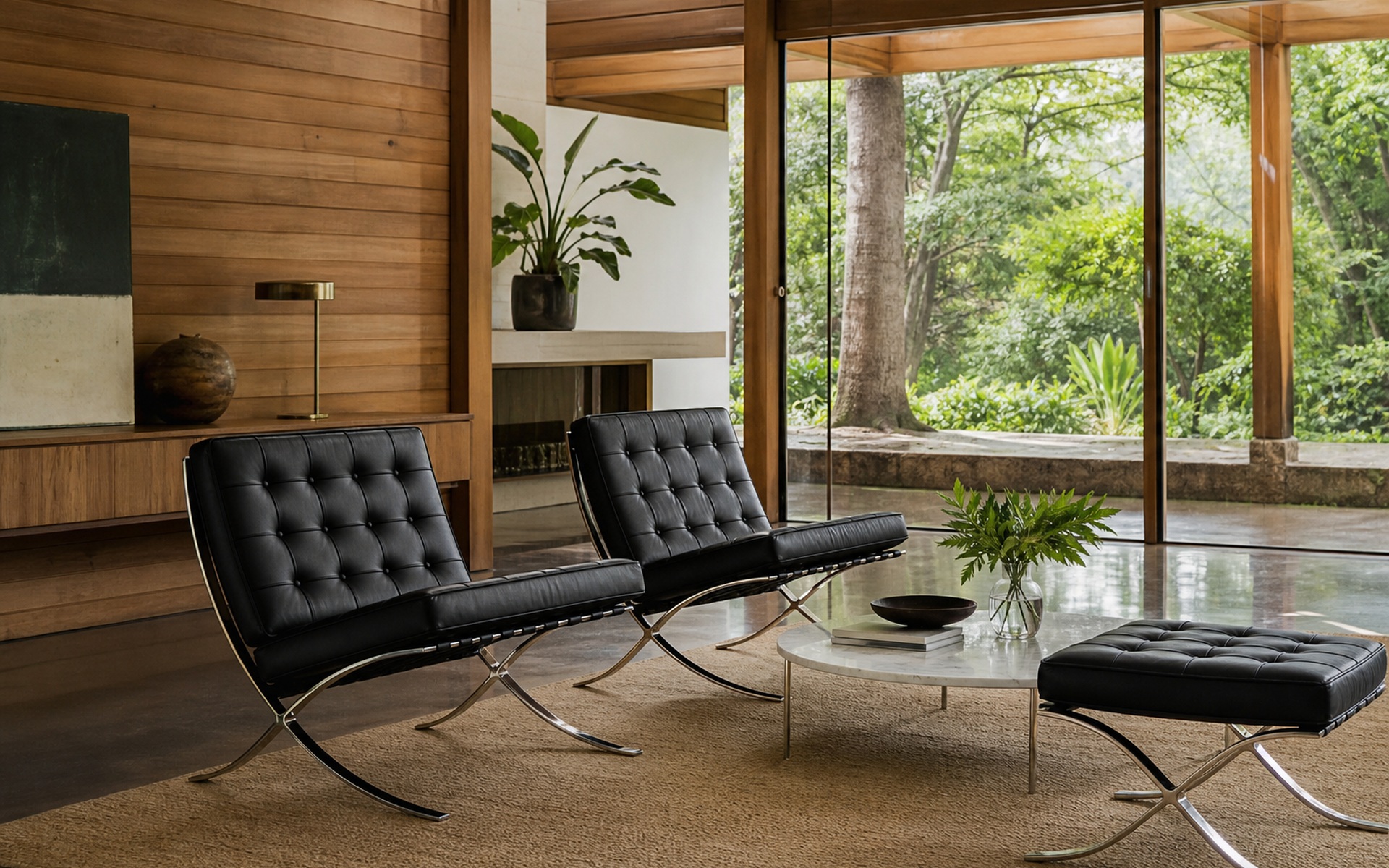
The design is one drawn line, repeated. Look at the chair side-on: the front leg and the back support are a single curve crossing a second single curve, a scissor, a Roman magistrate’s folding stool translated into machine-age steel. There is no back leg, no frame box, no visible fixings to interrupt the geometry. Everything above the steel is soft: forty individual leather panels per cushion in the authentic version, cut, welted and buttoned like luxury luggage. Where the LC collection in Paris that same year treated steel as honest industrial equipment, Mies and Reich treated it as aristocracy. The Barcelona chair is not equipment. It is ceremony. It does not ask the room to be efficient; it asks the room to behave.The honest knock
Three fair criticisms, all deserved. First, comfort: the chair holds you in a single low, wide, slightly reclined state that is superb for twenty minutes and noncommittal after forty, and getting out of one is an inelegant negotiation. Second, ubiquity: it has been the default signifier of corporate good taste for decades, and an object designed as a singular throne now waits in pairs outside a thousand glass conference rooms, which has dulled its aura through no fault of its own. Third, and most seriously, credit: Lilly Reich’s role in the pavilion’s interiors and furnishings was minimised for most of the twentieth century, and only in recent decades have institutions begun crediting her properly. The chair’s history is also a history of who gets remembered.Copies, and what they miss
The Barcelona chair may be rivalled only by the LC2 as the most counterfeited seat in the world. The tells are consistent. In the authentic chair the frame is one polished, seamless curve of stainless steel with a proud spring to it; copies bolt chromed segments together and the line dies at every joint. The scissor profile flattens, losing the taut arc that makes the original look drawn rather than welded. Cushion craft collapses from dozens of individually welted panels to a single stitched pad doing an impression of them. And the stance shrinks, because the original’s regal width is expensive width. The copy gives you the silhouette. The original gives you the ceremony, and ceremony is precisely the thing that cannot be faked. Nearly a century on, the throne that lost its king and its building still commands whatever room it enters. The pavilion had to be rebuilt around it. That is not a bad career for a chair.
Sources
- Barcelona chair, 1929 German Pavilion, design with Lilly Reich, Knoll production history and 1950 stainless frame. knoll.com
- German Pavilion history, 1930 demolition and 1986 reconstruction, Fundacio Mies van der Rohe, Barcelona. miesbcn.com
- Design for the visit of King Alfonso XIII; whether he ever sat is disputed. Legend, told as such. wikipedia.org
- Lilly Reich’s collaboration and later recognition. wikipedia.org

