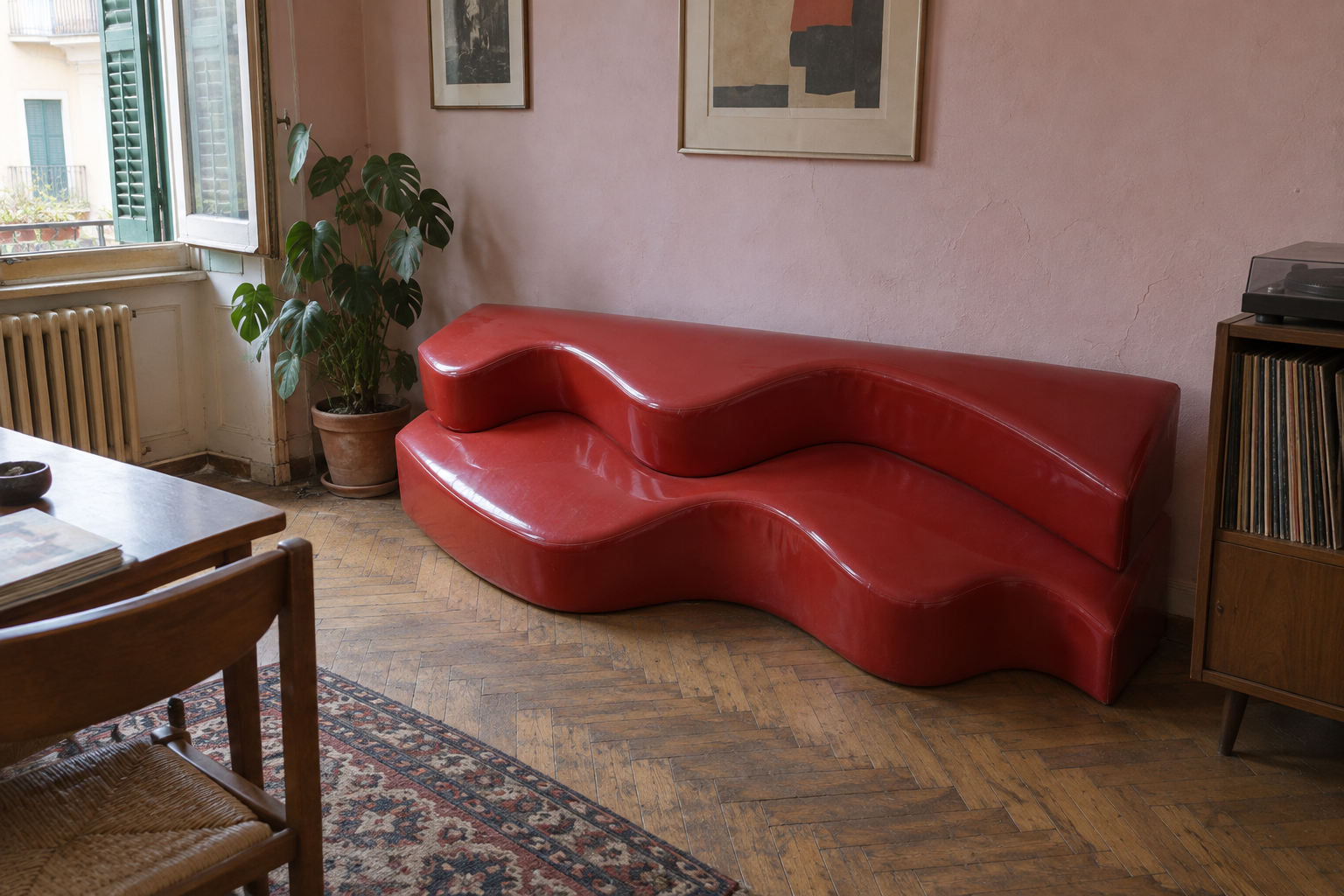
Archizoom’s 1967 sofa begins with two complementary foam shapes. The interesting part is what happens when they stop fitting neatly together.
Cut a block along a wavy line and the two resulting shapes remember each other. Bring them together and the block returns. Separate them, turn them, stack them, and the line begins to do something else.
That simple relationship is what keeps drawing me back to Superonda. The sofa begins with a cut, but it does not end with a single arrangement.
The line becomes furniture
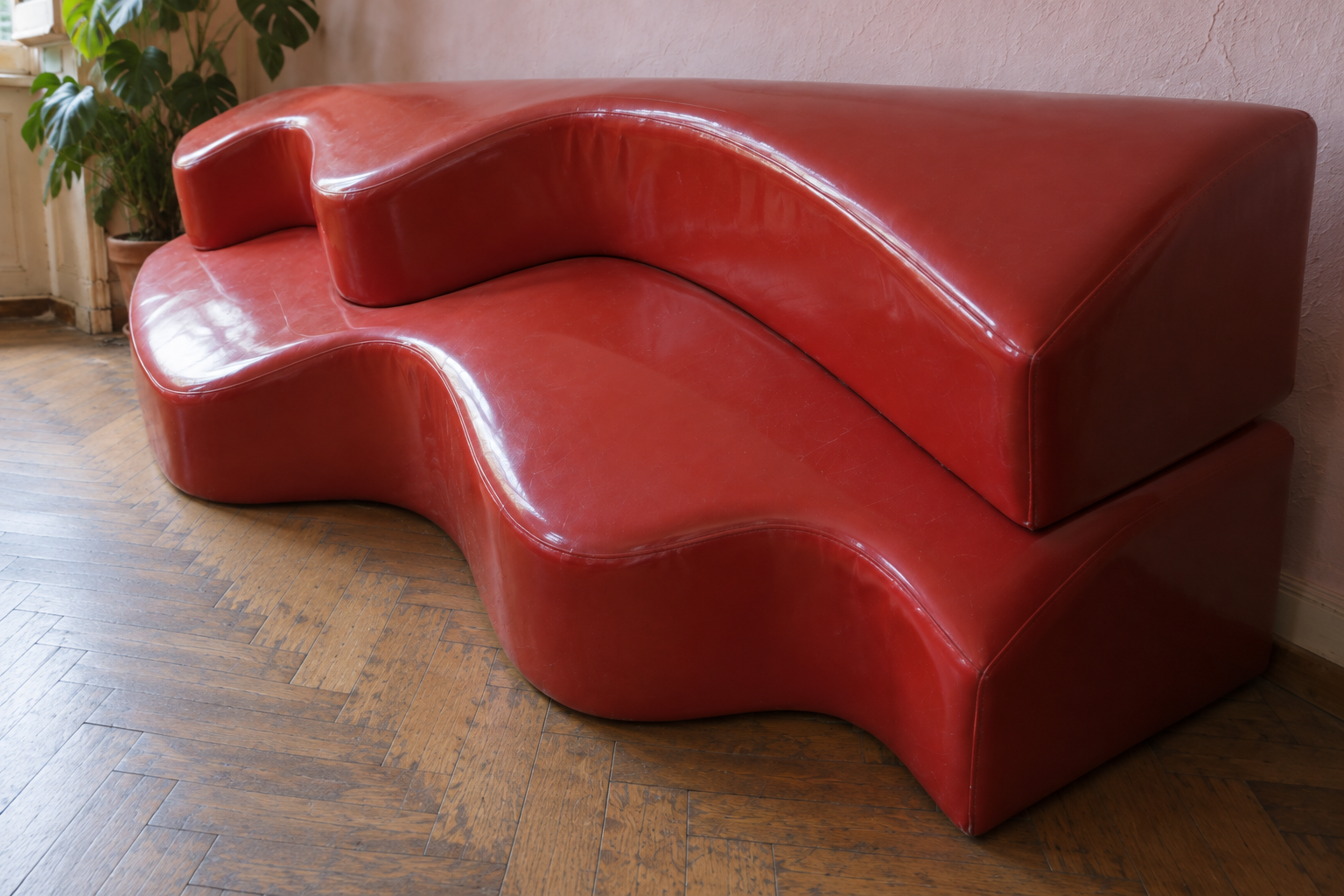
Poltronova dates Archizoom’s design to 1967. It describes two wave-shaped polyurethane elements made through an S-shaped cut, with a glossy PVC-coated fabric covering. They can be interlocked or stacked to form a sofa, bed or chaise longue.
The geometry is economical: the line defining one piece also defines its partner. Each curve belongs to both forms, an agreement that survives however far apart you move them.
There is no conventional upholstered frame determining one permanent arrangement. The foam shapes carry the proposition, and the covering makes the curves conspicuous. The glossy surface gives light a route along the wave.
One photograph is an incomplete explanation
A single photograph can make Superonda look like a rather strange fixed sofa. The next photograph changes the argument. The pieces have moved; the back has ceased to be a back; a reclining surface appears where the eye had expected a seat.
I like designs that ask us to make that second reading. The first image gives recognition. Another arrangement gives understanding. Superonda rewards the comparison because its components remain simple enough to follow.
The room changes around the two waves. A long low surface becomes an island. Move the pieces apart and the space between them becomes available again. The object asks for a little participation in deciding what the room is for.
The sofa begins with a cut, but it does not end with a single arrangement.
Freedom still takes up space
My reservation is practical. The freedom shown in an empty studio photograph needs a real floor plan in which to happen. A coffee table, a doorway or the rest of a household’s furniture can limit the arrangements long before the components do.
That is not peculiar to Superonda. Any flexible system has to negotiate with the room that receives it. I would want to know which arrangements are useful in that room, rather than count the number of possibilities in the abstract.
The materials matter too. On an older example, the foam’s condition affects the form as well as the feel. A worn covering over sound padding is a different job from reconstructing deteriorated foam. The design alone cannot tell us which condition we are looking at.
The waves are still here
Superonda remains in Poltronova’s collection. Its continued presence gives us an object to examine, not a set of sales figures from which to invent a story about success or failure.
I would keep it beside the Togo and Camaleonda as a different answer to flexible living. Where those collections offer families of seats or connected modules, Superonda makes much of the relationship between just two forms.
The pieces come together again. The wave disappears into its matching edge, and for a moment the block is whole. Move one half and the room starts over.
Continue through the archive: Togo and Camaleonda.
A Loom & Hide design-archive story.
Find your place to sit.
Explore Loom & Hide’s sofas, handcrafted in Woodstock, Cape Town.

