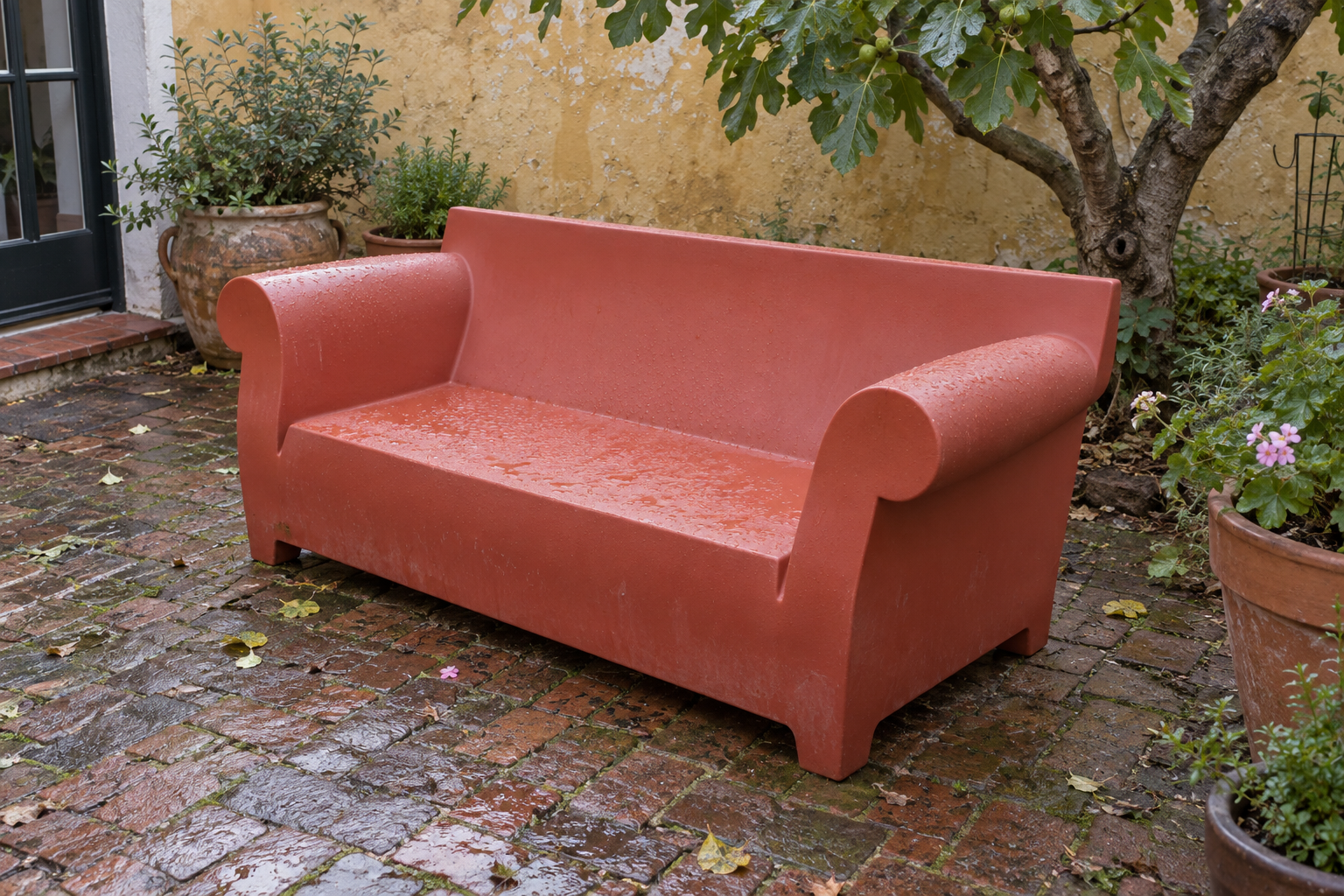
Philippe Starck kept the familiar rolled arms and changed the material. In polyethylene, the old indoor silhouette finds itself out on the lawn.
The club-room sofa has wandered into the garden. The rolled arms are still there, but the leather, buttoning and solemnity have gone. In their place is a hollow plastic form, looking oddly at home on the grass.
That is the pleasure of Bubble Club for me. The shape carries its old associations into a setting where they become faintly ridiculous.
The familiar outline
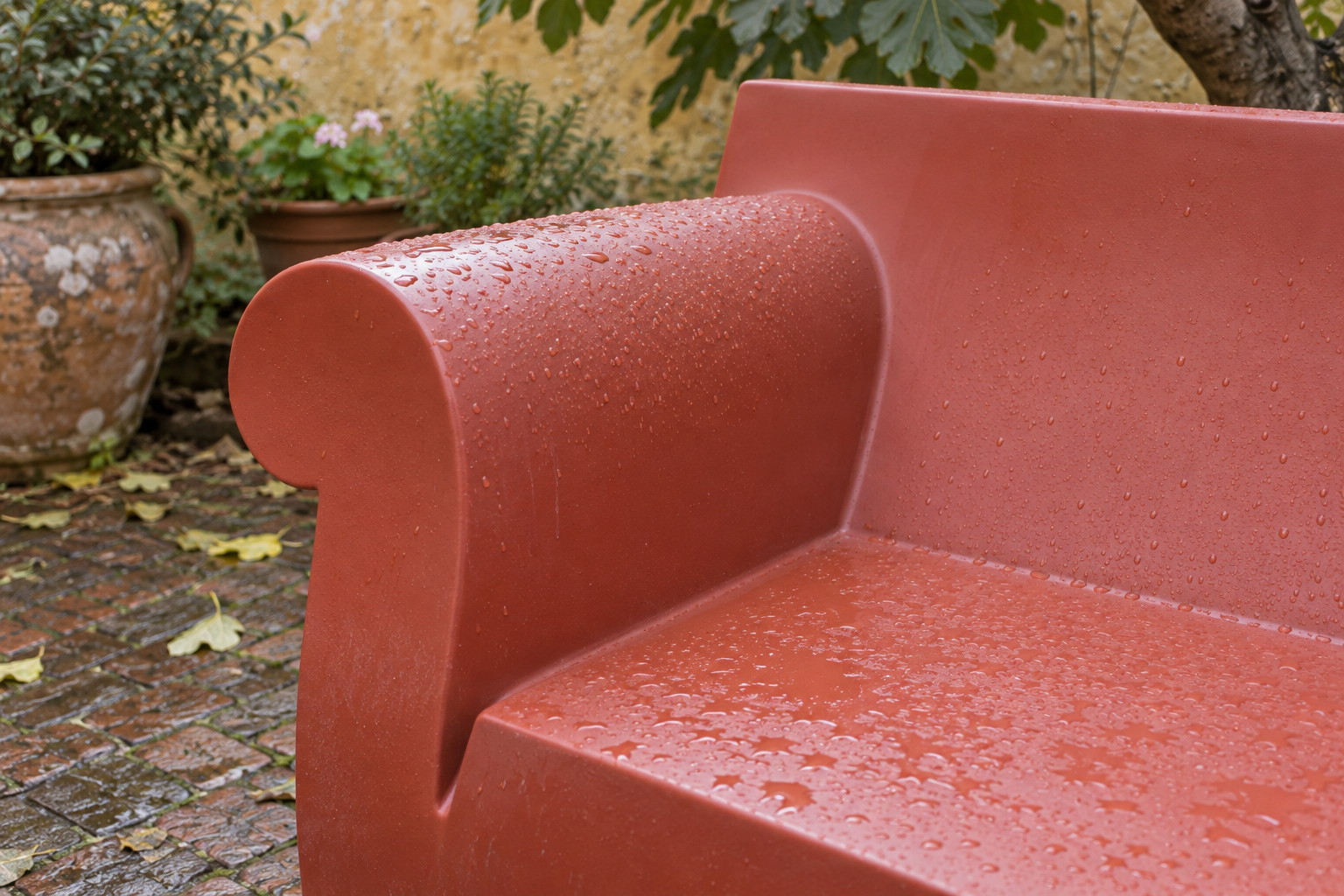
Philippe Starck’s own archive dates Bubble Club to 1998 and describes it as a rotomoulded polyethylene garden sofa for Kartell. Kartell presents the two-seater alongside an armchair and table, intended for gardens, terraces and poolside settings.
The rounded arms do much of the remembering. They suggest upholstered generosity, although the object offers a different material altogether. The back is plainer and more upright than the arms, giving the softness of the silhouette a firmer boundary.
It recalls a club sofa without reproducing every feature of a Chesterfield. That distinction helps the joke. Starck only needs enough of the old language to make the change in material legible.
A hollow form
In rotational moulding, polymer powder is heated inside a slowly rotating mould. As it melts and coats the interior, it forms the wall of a hollow object. Cooling allows the shape to be released. The process can produce a large continuous body without assembling the layers associated with conventional upholstery.
I find that substitution more interesting than a claim to have invented the first industrial sofa. A familiar outline has been carried into another manufacturing process. The material and the way of making it are part of what we see.
The arms no longer conceal the same kind of interior. There is no reason to read the generous curve as a promise of a soft cushion. Bubble Club lets the eye recognise one thing while the material supplies another.
The club-room sofa has wandered into the garden.
Out through the French doors
The curtains move. The room gives way to a terrace, then to grass. The old sofa outline crosses the threshold with us and loses much of its authority in daylight. Beside a pool, those arms look less like a declaration of status and more like an invitation to enjoy the absurdity.
That is where I like it best. Indoors, the material substitution is the first thing I notice. Outdoors, the setting joins the joke. A shape associated with enclosed rooms has become a piece of garden furniture.
Its suitability for outdoor use does not make it indestructible. Colour, finish, placement and maintenance still deserve attention. Nor does the hollow shell tell us how long somebody will want to sit in it. Those are questions for the actual object and its instructions, not conclusions to borrow from its cheerful appearance.
The shape remembers
Bubble Club suggests that a furniture silhouette can outlive the construction we associate with it. We recognise the arms before we know what they are made of. The memory arrives faster than the material information.
I like the way Starck uses that delay. For a moment the sofa belongs to the old room. Then the light catches the plastic, and the garden takes it back.
Continue through the archive: Togo and Camaleonda.
A Loom & Hide design-archive story.
Find your place to sit.
Explore Loom & Hide’s sofas, handcrafted in Woodstock, Cape Town.

