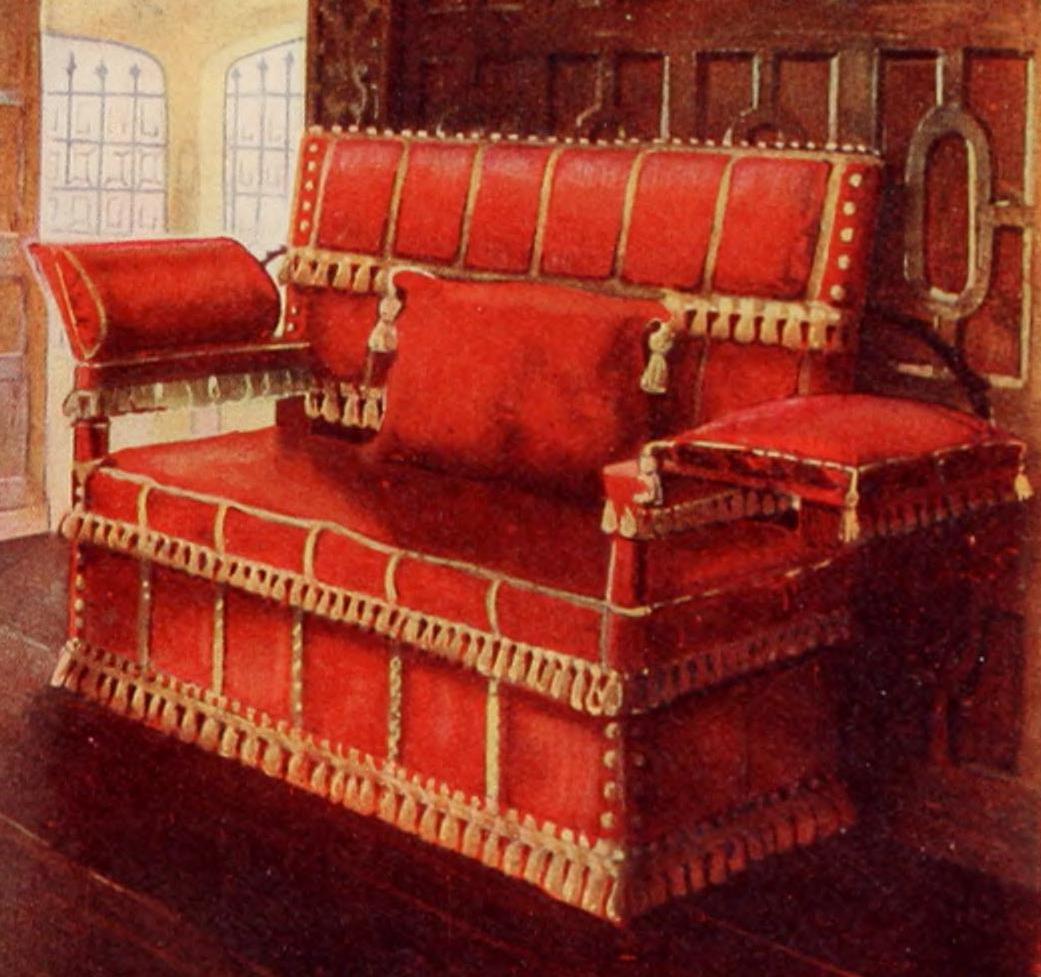
Crimson velvet, metal-thread fringe and adjustable sides. The old state couch at Knole carries a much longer history than its modern descendants suggest.
The room darkens as the centuries accumulate. Velvet deepens to crimson. A fringe catches the light. The couch stands among other seats, but it has no intention of disappearing among them.
I find the Knole sofa interesting because its grandeur has survived the journey into ordinary furniture catalogues. The cords and finials are familiar even to people who have never seen the object whose name they carry.
Before the sofa became ordinary
The National Trust identifies the original as a state couch, made in London around 1635–1640 by unknown upholsterers, probably suppliers to the Great Wardrobe. Its beech frame carries crimson silk velvet, decorative studs and gold-and-silver-thread fringe. It belonged to a larger suite of couches, chairs and stools.
Those details suggest a room in which upholstery did more than offer somewhere to rest. The materials, repetition and scale contribute to ceremony. I read the couch as a piece intended to hold attention as well as a body.
That does not settle exactly who sat where, or what every occasion demanded. The object is already eloquent without supplying a seating chart for a room we cannot fully reconstruct.
The sides can move
The most useful surprise is in the arms. The Trust records padded rests that can be raised or inclined on iron ratchets. Beneath the formal appearance sits a working adjustment.
I like the interruption that creates. We tend to give old furniture a fixed posture in our minds. The museum view encourages it: one angle, one arrangement, one object safely past the point of changing. Here the sides could move.
Open the outline and the couch has a different relationship to the space around it. Close it and the sitter is more enclosed. The mechanism survives as evidence of adaptability, even where the precise purpose of an adjustment remains less certain.
Beneath the formal appearance sits a working adjustment.
From a royal interior to Kent
The Trust connects the suite’s presence at Knole with Charles Sackville’s service as Lord Chamberlain. Royal furnishings judged due for replacement could become a perquisite of that office. Their transfer helped preserve objects that might otherwise have disappeared.
It is an extraordinary change of context. Furniture made for one institution survives in another household and eventually becomes something people travel to see. The useful object becomes the evidence.
I am drawn to that afterlife. Upholstery is vulnerable precisely because people use it. Coverings are replaced, frames repaired, rooms refurnished. A surviving early couch is not simply an old shape; it is material that has made its way through centuries of decisions about what to keep.
The name leaves the house
Later Knole-style sofas carried the enclosing outline and adjustable-side idea into very different interiors. The family resemblance can be strong, but a modern example is not a specification for the old state couch, nor does the old object decide how a new one will feel.
My reservation is visual. The tied sides and finials can become a shorthand for importance, particularly when everything around them is making the same announcement. I prefer a room that lets an old form keep a little strangeness rather than dressing every other object to match it.
The couch at Knole has already travelled from ceremony to survival to imitation. Its name can now arrive in a house long before anyone learns where Knole is. The doors keep opening. The crimson couch remains behind them.
Continue through the archive: Togo and Camaleonda.
A Loom & Hide design-archive story.
Find your place to sit.
Explore Loom & Hide’s sofas, handcrafted in Woodstock, Cape Town.

