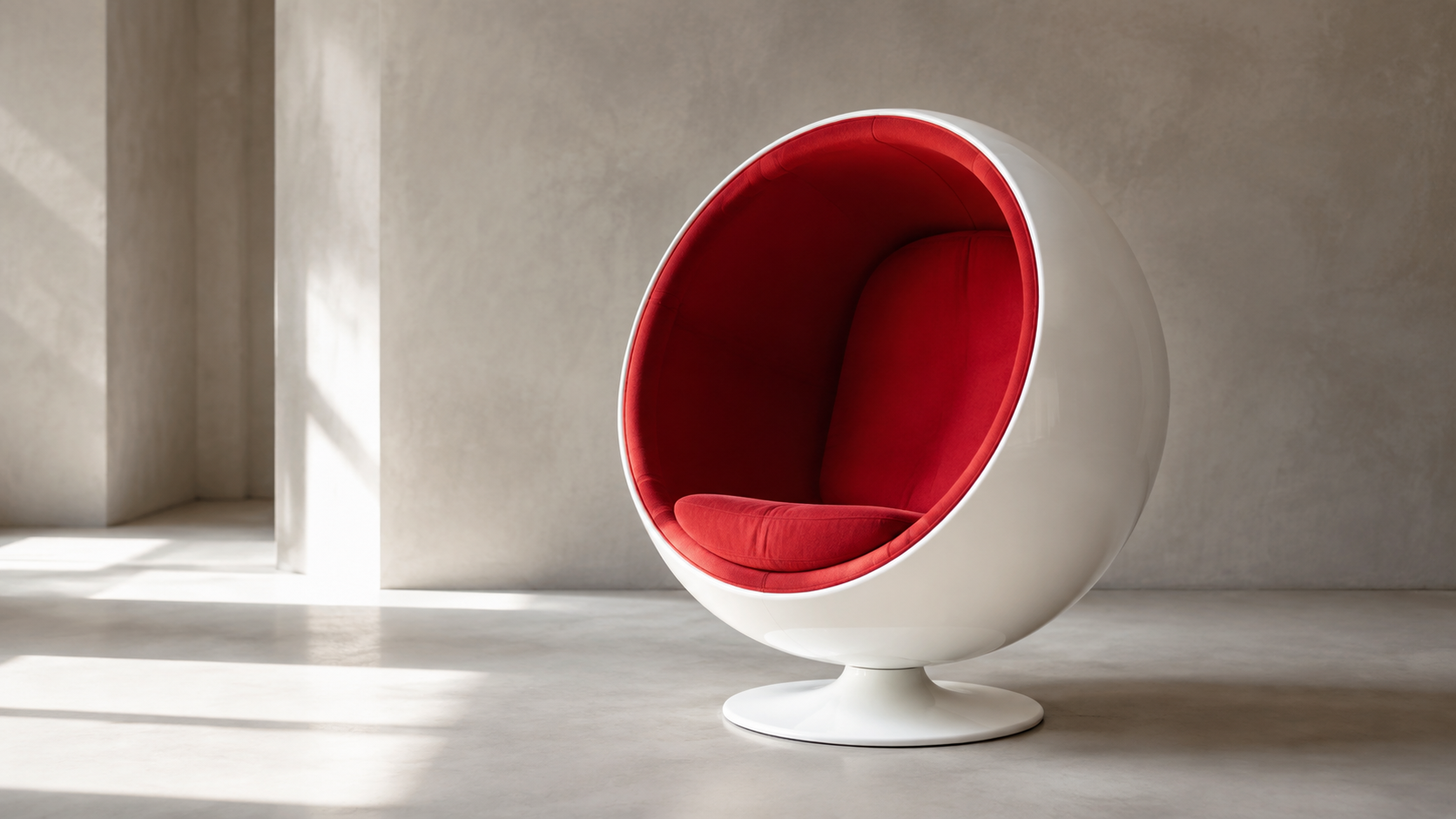
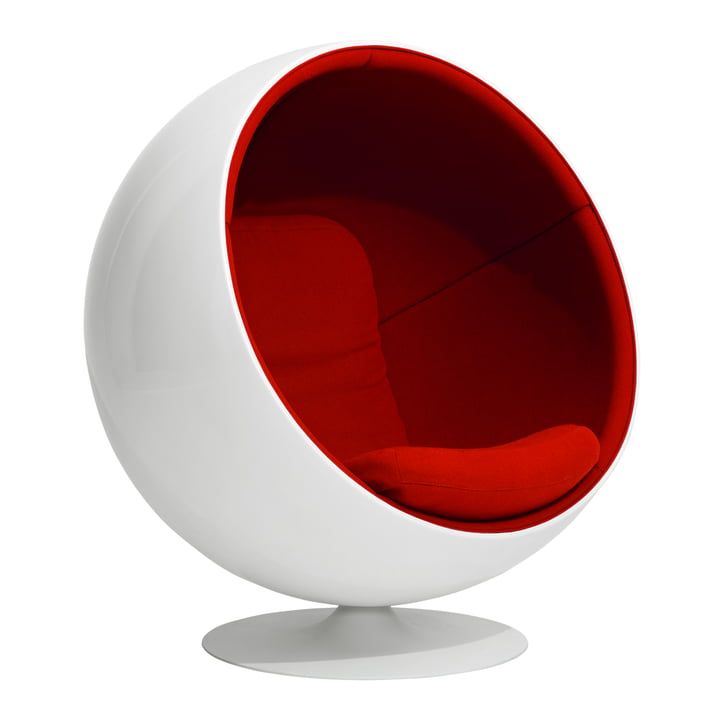
Some furniture you admire. The Ball Chair you fall for, and usually you fall for it as a child, long before you know its name, its price, or the small Finnish town it came from. You just see a hollow white sphere with a soft red mouth, and something in you quietly decides that one day you are going to climb inside it and pull the world shut behind you.
I have wanted one for as long as I can remember. And I know exactly where the wanting started, and it was not in a design museum.
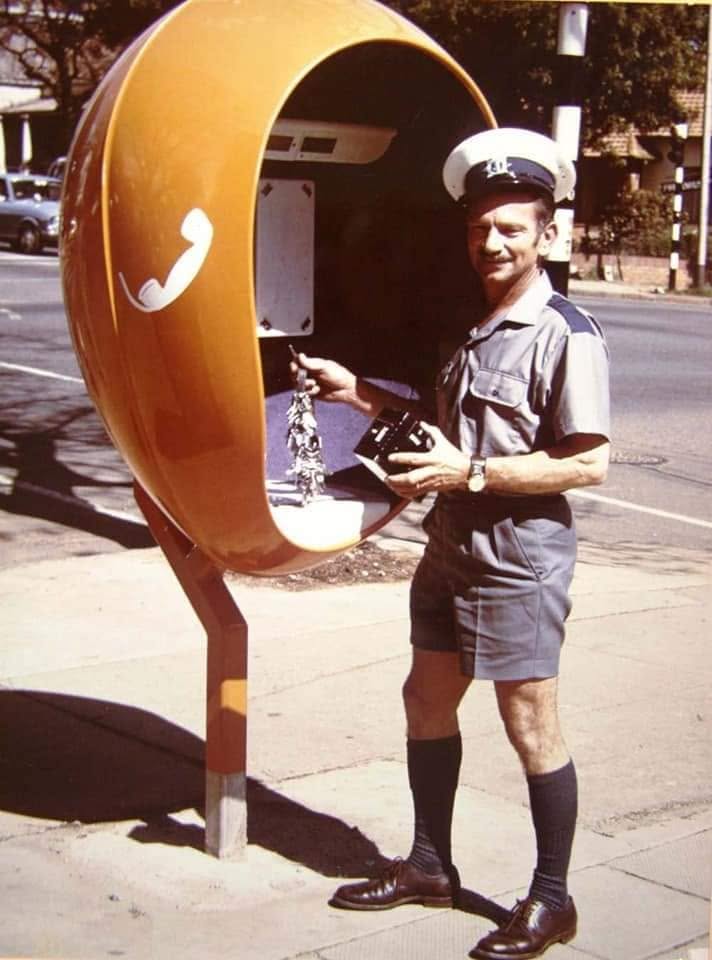
Where I grew up, a version of that same magic was parked right on the pavement. A bright orange egg on a single steel leg, open on one side, just big enough for one body and a telephone. You climbed up into it, the street noise fell away, and for the length of one call the whole world shrank to the inside of a smooth plastic shell. We did not know we were sitting in space-age design. We just knew that making a phone call from inside an orange egg was about the best thing that could happen to a kid on a slow afternoon. You were out in the open and completely hidden at the same time.
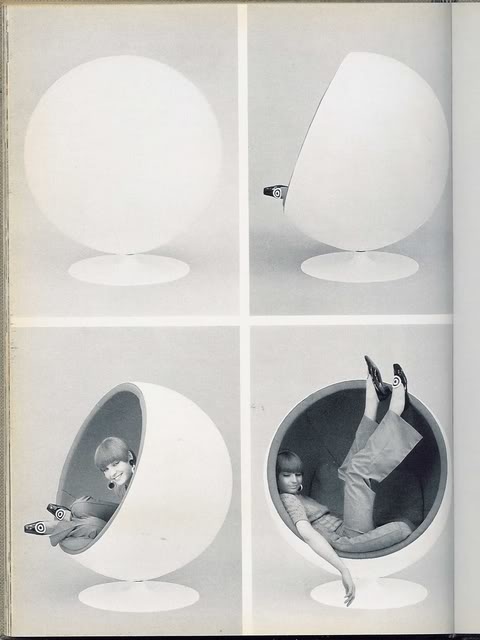
The Ball Chair is that exact feeling, brought indoors and made beautiful. It makes the same promise the egg on the corner made: a private little planet, a way out of the room without leaving it, somewhere you can actually hear your own thoughts because the shell is holding the noise at bay. Eero Aarnio even understood the phone part. Some Ball Chairs were built with a telephone fitted right inside the curve of the shell, so you could fold yourself into your bubble and talk to the outside world without ever fully rejoining it.
A young Finn, some fibreglass, and one very good idea
Eero Aarnio was a young Finnish designer in love with two things: pure geometry, and the strange new freedom of plastic. Fibreglass did not care about the old rules of legs and frames and joints. It could be poured into one continuous shape, and a sphere is about as pure and hopeful a shape as there is. He built the first Ball for his own home around 1963, out of the simple wish to have a bigger, quieter chair to sit in. The Finnish maker Asko put it into production, and when it appeared at the Cologne furniture fair in 1966 it stopped people in their tracks. Suddenly the future had somewhere to sit.
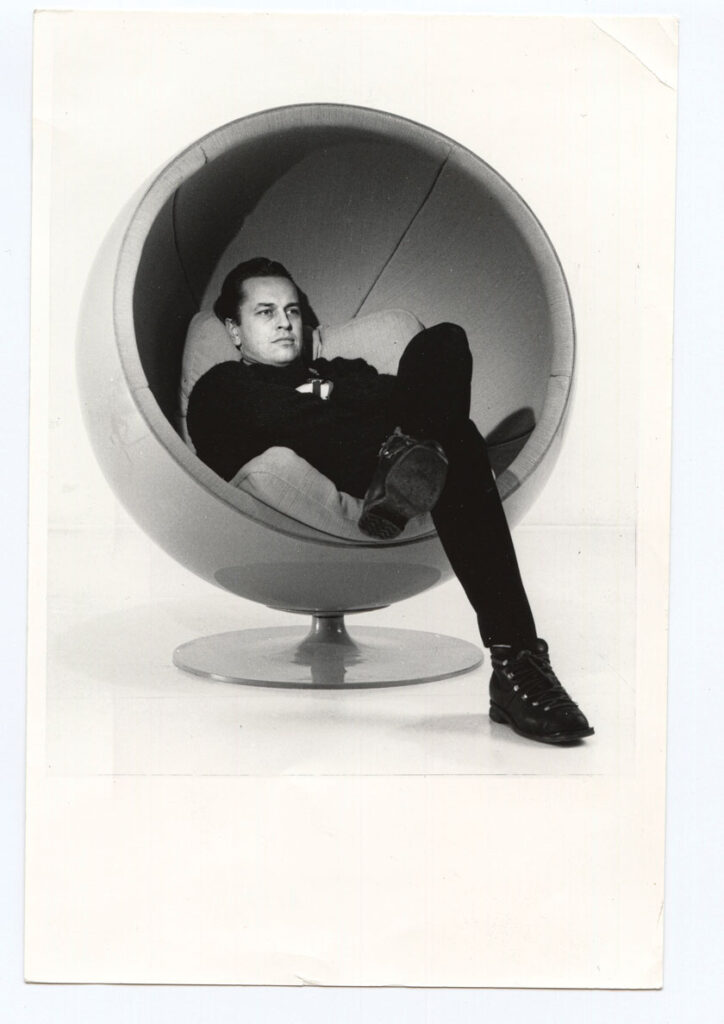
There is a lovely honesty to the fact that he made it for himself first. It was not a product dreamed up in a boardroom. It was a man who wanted his own quiet corner and had the nerve to make it round, white and impossible to ignore. Almost everyone who meets one as a child makes the same silent promise he did: one day, that will be mine.
The decade that wanted to live in a pod
Aarnio was riding a wave. He would soon follow the Ball with the clear hanging Bubble and the round little Pastil. In Italy, Joe Colombo had already curled the Elda chair into a great enveloping shell. Verner Panton was pouring whole chairs out of single moulds. The 1960s were convinced the future would be smooth, white and slightly weightless, and plastic finally let designers build it. The sphere, the egg, the capsule: these were the shapes of a decade that wanted to wrap the human body in a soft, hopeful shell.
And that egg-shaped optimism did not stay indoors. It rolled out onto the street, into airports and lobbies, and yes, onto the pavement as a bright phone booth you could disappear into. For a while the whole world seemed to agree that the nicest thing you could do for a person was give them a smooth round shell to sit inside for a few minutes, alone with their thoughts or a telephone.
Why it still pulls at us
Let us be honest, it is not the most sensible chair ever made. It swallows a corner, it is a graceless thing to climb out of, and it hides your face and muffles your ears, which is either the whole point or a small betrayal depending on your mood. But nobody has ever loved a Ball Chair for being sensible. We love it because it remembers something most of us felt as children and then quietly lost: that a room can hold a secret, that you can be present and hidden at the same time, that comfort can also be a hiding place.
Sixty years on, it still does the one thing it promised in 1966. You climb in, you swivel away from the noise, and the world becomes only as wide as the circle in front of you. I wanted one as a kid for the same reason I loved that orange egg on the corner. It was never really about the furniture. It was about having somewhere to disappear to, and coming back out only when you were good and ready.
A Loom & Hide design-archive story. We write about these pieces for the love of the ideas.

