A 23-year-old at the Bauhaus looked down at his new bicycle and saw a chair nobody had built yet.

The most influential chair of the twentieth century began its life as a bicycle.
In 1925 Marcel Breuer was twenty-three years old, newly appointed head of the furniture workshop at the Bauhaus in Dessau, and the proud owner of an Adler bicycle. The story he told for the rest of his life is that he kept staring at the handlebars. Here was steel tube, bent into tight curves, light enough to lift with a finger, strong enough to take a grown man’s weight over cobblestones, and manufactured by the thousand. If steel tube could do that for riding, why was nobody asking it to do the same for sitting? Wood needed joints, glue, carving, patience. Tube needed a bending machine. Breuer got his tubing from the same industry that supplied plumbers and aircraft builders, worked with a local craftsman because the Bauhaus workshops were not set up for it, and produced the B3: a cube of gleaming bent steel with the sitter suspended inside it on taut slings of fabric. Nobody had seen anything like it. The seat, back and arms are nothing but stretched bands, floating in a frame that seems to be drawn in the air rather than built. Breuer said his first thought was that of all his chairs, this one would attract the most criticism. He was right, and it made him famous anyway.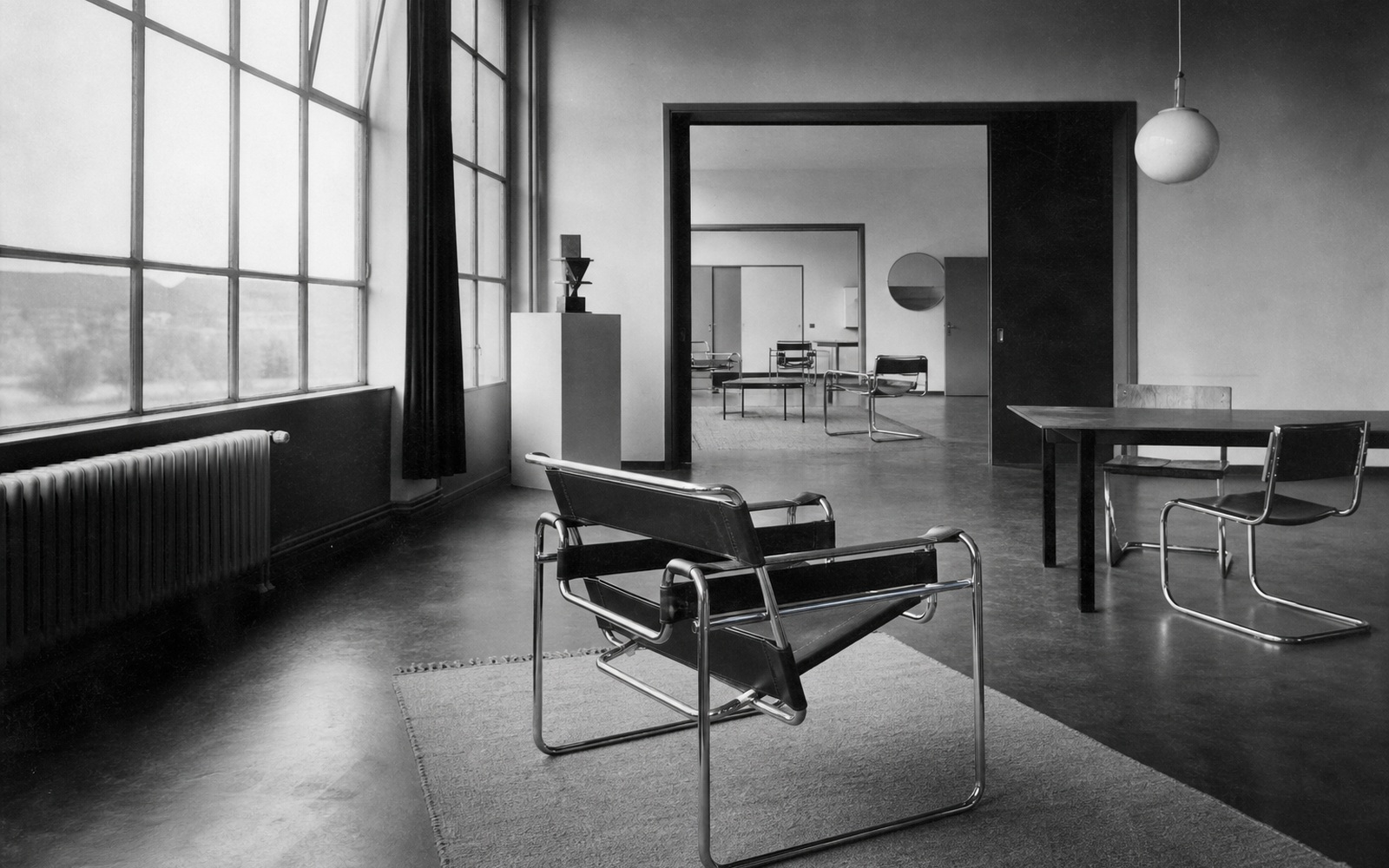
The chair that started the steel arms race
The B3 was the opening shot in what became modernism’s great materials war. Within a year Mart Stam had bent gas pipe into the first cantilever chair. Within four, Mies van der Rohe had answered with the Barcelona chair and the Paris studio of Le Corbusier, Jeanneret and Perriand had shown the whole LC collection, cushions caged in exactly the kind of exposed steel Breuer had legitimised. Every chrome-framed chair in every office lobby on earth is downstream of a Hungarian junior master and his bicycle. The name came later, and by accident of friendship. The painter Wassily Kandinsky, Breuer’s colleague at the Bauhaus, admired the prototype and got one of the first examples for his quarters. When the Italian manufacturer Gavina revived the design in the 1960s and learned the Kandinsky story, they renamed the B3 the Wassily, and the marketing stuck harder than the history. Knoll acquired Gavina in 1968 and has made the chair ever since.“The seat and back are nothing but stretched bands, floating in a frame drawn in the air.”
How to see it
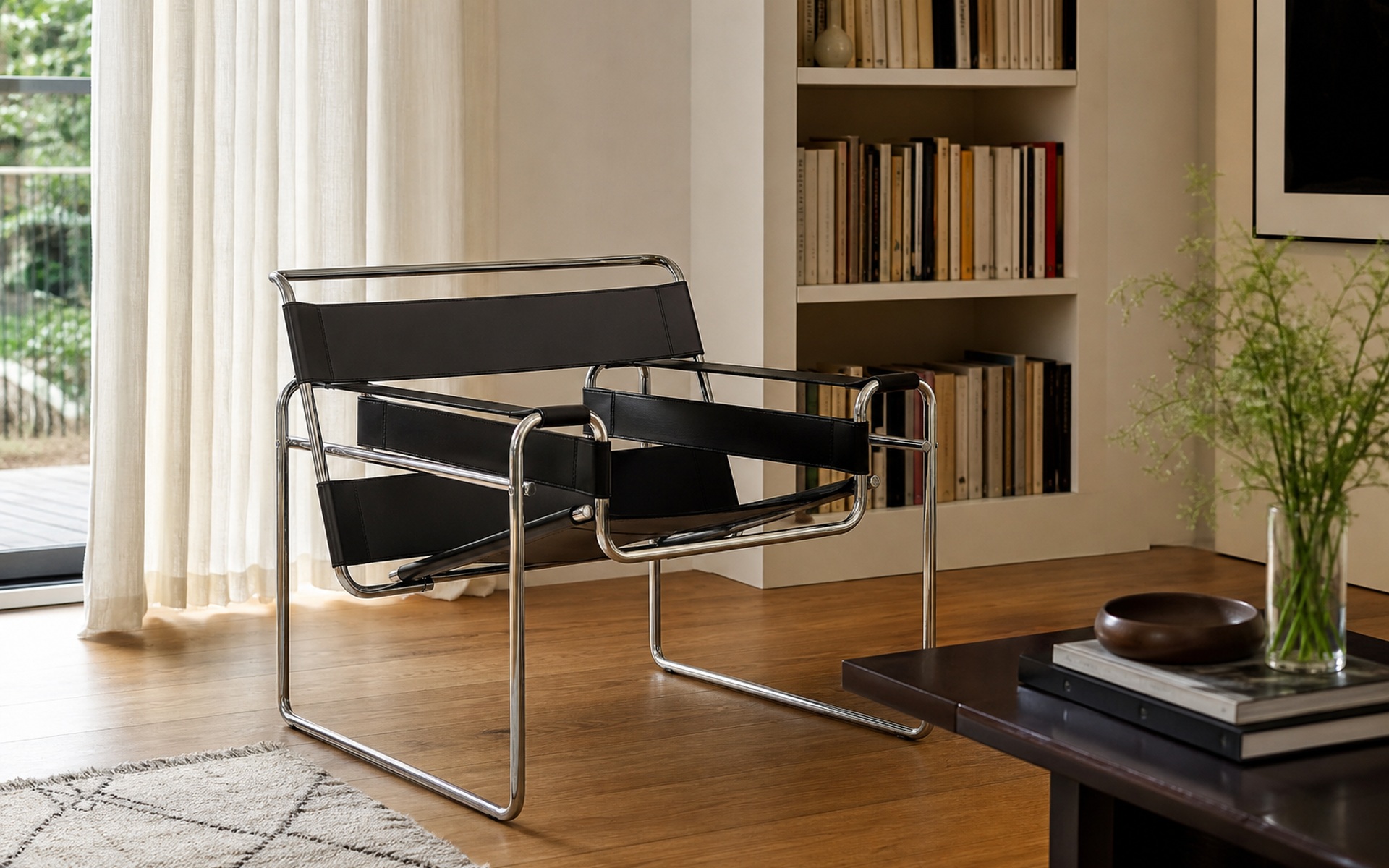
Stand a Wassily in an empty room and walk around it once. The first thing you notice is that you can see through it. There is almost no mass, just line and plane. The frame is a single continuous thought, loops of tube crossing and returning, and the leather bands slice through the cube like planes in an abstract painting, which is fitting for a chair named after an abstract painter. Then sit in it, and notice what it asks of you. The seat sling tilts you back, the arm bands hold your forearms at one particular height, and the whole machine locks you gently into a single alert, reclined posture. You do not lounge in a Wassily. You occupy it, the way you occupy the driver’s seat of a car. I finally understood this in the place the chair was born. The Bauhaus building in Dessau still stands, restored and open to visitors, and its interiors still hold Breuer’s tubular furniture. Seen there, against Gropius’s glass curtain wall, the chair stops being a lobby ornament and becomes what it was in 1925: a piece of the building’s own logic, architecture at the scale of the body.The honest knock
Say it plainly: the Wassily is not a comfortable chair by any modern standard. It offers one posture, its straps give perhaps a centimetre, winter leather is cold and summer leather is sticky, and getting out of one with dignity is a learned skill. It is also, at this point, a corporate cliche, bought by the pair to signal taste in reception areas where nobody ever sits. None of that is the chair’s fault. It was designed as a research result, not a nest, and as a research result it has never been improved on. But if what you want at the end of the day is surrender, its descendants and rivals in soft modernism, from the Womb chair to the low-slung Maralunga, exist precisely because the Wassily refused to provide it.Copies, and the tell
The Wassily has been pirated for a century, and the fakes betray themselves in the same few places. The tube gauge runs thin, so the frame flexes and the drawn-in-air quality collapses into flimsiness. The bends lose their tight, even radius and go lazy at the corners. The slings are cut from thin split leather that bags within a year, where the original’s thick belting leather stays drum-tight. And the proportions drift, a few centimetres here and there, until the strict cube dissolves. The original is a set of exact tensions. The copy is a picture of a chair. A century on, the B3 remains the purest statement of the idea that made modern furniture possible: that industry, honestly used, could be beautiful. Breuer found it on his handlebars. We have been sitting in it ever since.
Sources
- Wassily chair (Model B3), Marcel Breuer, 1925, design and production history, Knoll. knoll.com
- B3 history, Adler bicycle inspiration, Kandinsky connection and Gavina renaming, Wikipedia. Verified against multiple design histories; the bicycle story is Breuer’s own account, told as such. wikipedia.org
- Marcel Breuer at the Bauhaus, furniture workshop appointment 1925, Bauhaus Dessau Foundation. bauhaus-dessau.de
- Knoll acquisition of Gavina, 1968. wikipedia.org

