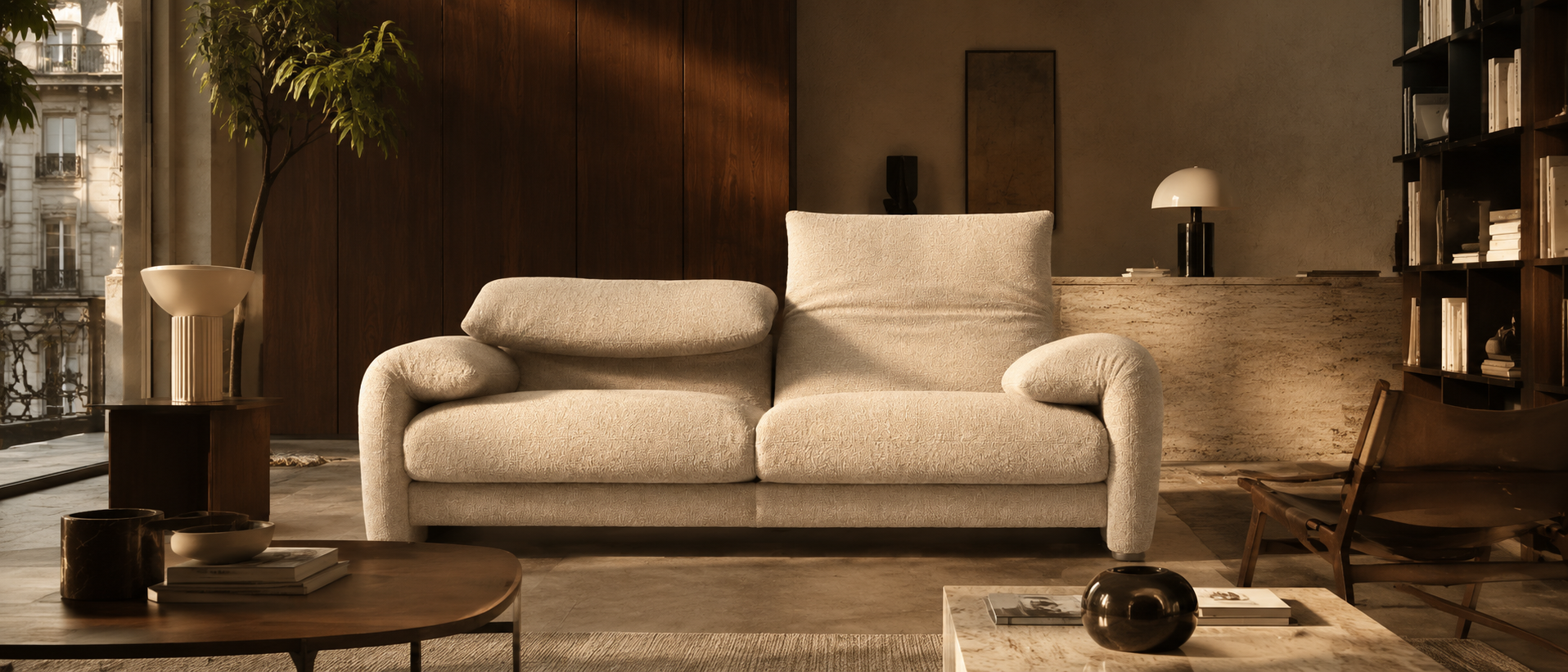
In 1973 the radicals were lowering sofas to the floor and bursting them into cubes. Vico Magistretti did something quieter and cleverer: he gave the sofa a collar it could raise at will.
It is 1973, and everyone seems to be trying to get comfortable with a world that will not sit still.
The first handheld mobile phone call has just been made in New York, a strange little prophecy on a Manhattan sidewalk. Pink Floyd’s The Dark Side of the Moon is playing in rooms where people are beginning to understand that the future may not feel as clean and heroic as the previous decade promised. Watergate is turning authority into a televised spectacle. By October, the oil crisis will make the modern world feel suddenly dependent on things it thought it controlled.
In Italy, the 1970s are tense, inventive and unsettled. The country is deep inside the Years of Lead. The optimism of postwar industry is still there, but it is no longer innocent. Milanese design is producing soft, clever, radical furniture while the streets outside carry strikes, politics and a constant sense of argument. The home is supposed to be a refuge. But what kind of refuge works in a decade like this?
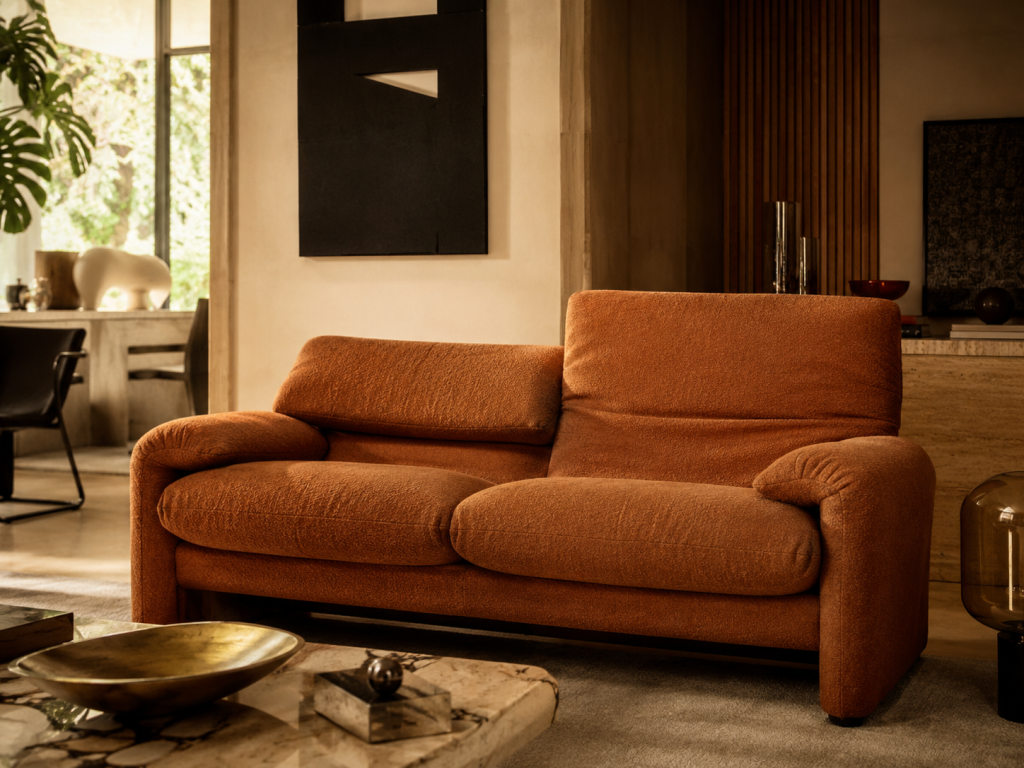
Vico Magistretti’s answer is not to make the sofa lower, stranger or louder. He gives it a collar. The Maralunga looks almost conservative at first. That is part of the trick. It has the familiar body of a proper upholstered sofa: soft arms, generous cushions, a domestic shape you can understand immediately. It does not arrive like a provocation in the way Togo does. It does not scatter into padded squares like Camaleonda. It does not look caught in a chrome clamp like Soriana. It sits there, reassuring you.
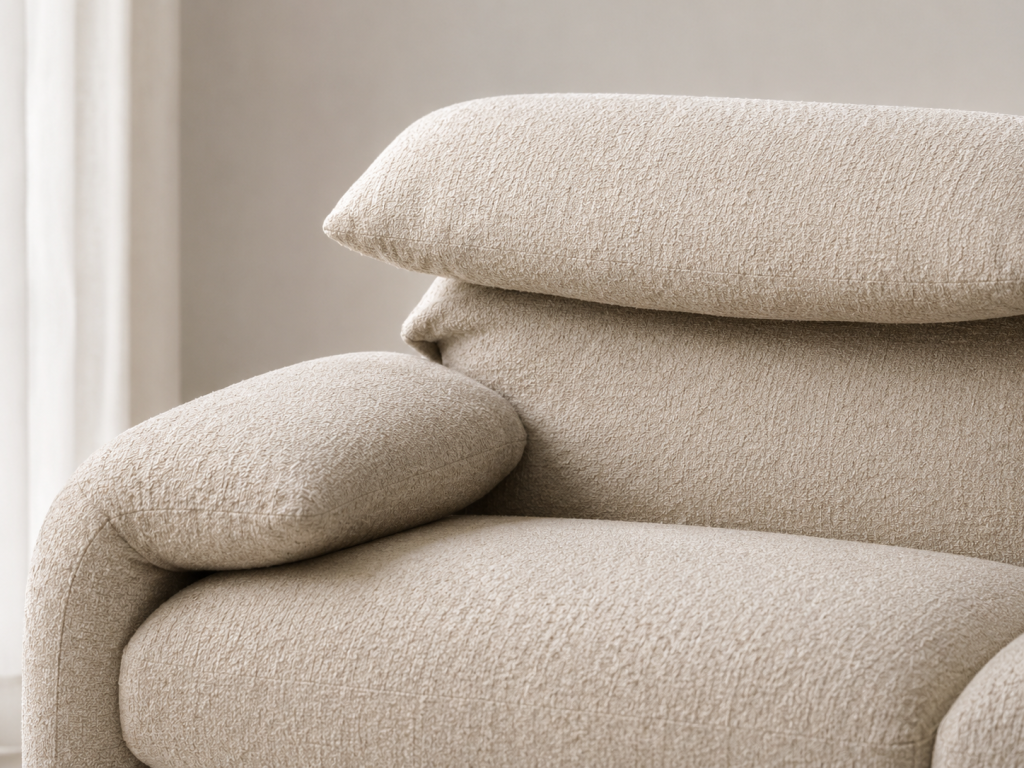
Then the backrest lifts. Suddenly the polite sofa becomes a different object. The cushions rise behind your shoulders, turning a conversational seat into a deeper, more private place. The sofa has changed its mind without changing rooms. That is why Maralunga matters.
“It made comfort adjustable without making it ugly.”
The punch that became a feature
The story of Maralunga begins with one of those design legends that sounds too good to ignore. According to the well-travelled version, Cesare Cassina saw an early prototype by Vico Magistretti and was not satisfied. It was too simple, too ordinary, not comfortable enough. In frustration, he struck the cushion. The impact made the top of the backrest fold down. Magistretti noticed.
A lesser designer might have seen a ruined prototype. Magistretti saw a mechanism hiding inside an accident. What if the backrest could move? What if a sofa could be formal when you wanted conversation and higher when you wanted to withdraw? What if comfort was not a fixed shape, but a gesture? That is the moment Maralunga becomes interesting. Not because someone punched a cushion. Because Magistretti understood the punch as information.
His best work often has this kind of intelligence. Vico Magistretti was not a designer of decorative excess. He was an architect-designer of simple, memorable ideas: the Eclisse lamp, the Atollo lamp, the Carimate chair, the kind of objects that look inevitable once they exist. He had a gift for making cleverness feel calm. Maralunga hides a small revolution inside a sofa your parents might approve of.
A quiet rival in a noisy decade
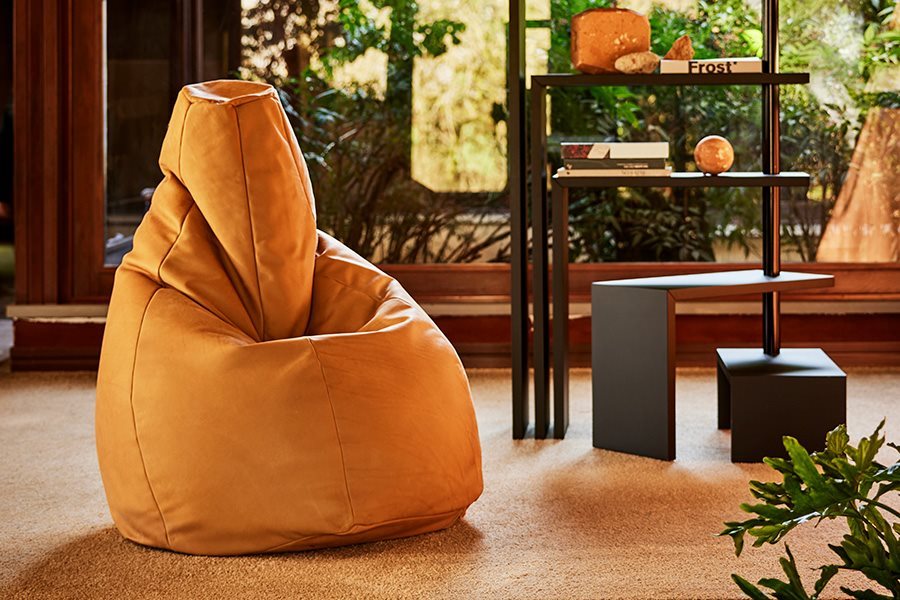
- 1968. Sacco turns the chair into a bag the body has to fill.
- 1970. Camaleonda makes the living room a modular padded map; Joe arrives as a giant baseball glove.
- 1973. Togo removes the visible frame and drops the body toward the floor; Maralunga keeps the familiar shape but gives it a collar that lifts.
The early 1970s sofa field was not short of drama. Sacco had already turned the chair into a bag. Soriana had made upholstery look squeezed and held under pressure. Camaleonda had turned the living room into a modular padded map. Togo would soon remove the visible frame altogether and ask the body to come closer to the floor. Next to all that, Maralunga could almost look restrained. But that restraint is deceptive. Maralunga was not trying to out-weird the decade. It was solving a more domestic problem: the same sofa has to serve different moods.
During the day, people sit upright. They talk. They host. They read the newspaper. At night, they sink. They watch television. They listen to records. They lean back after dinner. Most sofas choose one version of the body and force every moment to fit it. Maralunga says: why choose? With the headrest down, it keeps a lower, more conventional profile. With the headrest up, it becomes taller, more enveloping, more protective, almost as if the sofa has pulled up a coat collar against the weather. It does not simply adjust. It changes mood.
The bicycle chain inside the cushion
The Maralunga’s charm depends on the gap between what you see and what is happening inside. From the outside, the movement feels almost casual. The back comes up. The cushion changes posture. But inside that softness is a mechanism, originally described by Cassina as a simple bicycle chain inserted into the structure. That detail is wonderful because it is so unpretentious. A bicycle chain belongs to movement, repair, grease, wheels, practical intelligence. Hidden inside the foam, it gives the Maralunga its defining trick: instantaneous adjustment from a lower, more formal position to a higher one for relaxation.
A poor Maralunga-style sofa can copy the outline. It can give you big arms, soft cushions and a headrest that appears to lift. But the real test is how that movement feels after a thousand ordinary uses. Does the headrest stay where it should? Does it rise with the right resistance, or collapse into the back like a tired cardboard flap? The cheap copy understands the picture. The real Maralunga understands the habit.
Because the design is not only the up-position or the down-position. The design is the transition. The little decision your hand makes without ceremony. Up for a film. Down for guests. Up for reading. Down when the room needs to look calmer. The sofa becomes a domestic switch. That is much harder to fake than a silhouette.
The sofa as a family invention
Magistretti said he wanted Maralunga to embody a family-oriented idea of interior design: warm, relaxing, protective, the kind of comfort associated with an old reading chair near a fireplace or a window. That quote matters because it complicates the object. In the same decade that produced radical furniture, anti-furniture, pop furniture and low-slung rebellion, Maralunga is almost tender. It is not trying to destroy the old idea of the living room. It is trying to make it more responsive.
This is why it feels different from Togo or Camaleonda. Togo says the old rules are ridiculous. Camaleonda says the room should be rearranged. Soriana says softness can be dramatic. Maralunga says comfort should have manners, but not be trapped by them. There is something deeply Milanese about that. Not shy exactly, but controlled. Cleverness under the surface. Luxury that does not need to shout.
Imagine seeing it in a Milan showroom in the mid-1970s, where Italian design did not feel like decoration but like industrial culture made domestic. At first, you might walk past it too quickly. It is not the strangest thing in the room. Then someone lifts the backrest. The sofa changes expression. That is the moment. You realise the furniture is not passive. It has a second life built into it.
Why it stayed when others became period pieces
Some 1970s icons are tied so closely to their decade that they struggle to escape it. They come back as nostalgia first, design second. Maralunga has aged differently because its idea is not tied only to a look. It is tied to behaviour. People still need a sofa that can change from social to private. They still want softness without shapelessness. They still want furniture that understands the difference between sitting with others and sitting alone.
That is why Maralunga has remained in production and why it has been updated over time rather than simply revived as a period piece. The anniversary editions sharpened the look, introduced different upholstery treatments and kept the object contemporary. Cassina’s later research with Fondazione Magistretti even reinforced the internal mechanism to give the backrest additional inclination, proving that the story of the sofa is still about movement, not only appearance.
This is also why its imitators are everywhere. Adjustable-headrest sofas became normal. The detail that made Maralunga surprising has been absorbed into the grammar of contemporary furniture. But most of them lack the poetry. They treat adjustability as a feature. Maralunga treats it as character. A feature says: this sofa can do something. Character says: this sofa knows when to behave differently.
The pleasure of a sofa with two moods
The Maralunga’s impact is quieter than Togo’s, but no less important. Togo changed the room by lowering the body. Camaleonda changed the room by making the plan editable. Soriana changed the room by showing comfort under pressure. Maralunga changed the room by giving a sofa a second posture. That sounds simple, but simple ideas are often the ones that spread furthest. It took a mechanical solution and wrapped it in domestic warmth. It let the living room remain respectable while quietly becoming more relaxed.
That is why I like it. It does not demand that you live radically. It simply admits that you are not the same person all day. In the afternoon, you may want the sofa low and open. In the evening, you may want it higher, closer, more protective. With people, you may want conversation. Alone, you may want shelter. Maralunga understands that a living room has weather.
To see it properly is to see a sofa caught between politeness and surrender. Back down, it is almost conventional. Back up, it becomes more intimate, more enveloping, slightly more theatrical. It is the same object, but the mood has shifted.
“You do not negotiate with Maralunga the way you negotiate with Togo. You confide in it.”
You sit down, lift the backrest, and the room becomes a little less public. That is when the sofa starts doing its real work.
A Loom & Hide design-archive story. We write about these pieces for the love of the ideas; we do not make replicas or copies of protected original designs.

