It begins, as good Italian design stories often do, with pressure.
Not the slow, romantic pressure of a designer waiting for inspiration in a beautiful studio. Real pressure. Deadline pressure. The kind that makes a chair, a sofa, a sketch, a material and an argument all arrive at once.
It is late 1969. Italy is not calm.
Apollo 11 has landed on the Moon, but on Earth the mood is less weightless. In Northern Italy, the Hot Autumn is filling factories with strikes, wage demands and arguments about labour, class and power. Milan, Turin and the industrial north are loud with protest. In December, the Piazza Fontana bombing will turn the atmosphere darker still. The future feels technologically miraculous and politically unstable at the same time.
And inside this Italy, Cesare Cassina wants something radical.
The story goes that Cassina called Afra and Tobia Scarpa in November 1969 with an urgent brief: create a new seat in time for the Cologne trade fair in January. It sounds almost unreasonable. A revolutionary sofa, please. Quickly.
The Scarpas did not answer with a polite object.
They answered with Soriana.
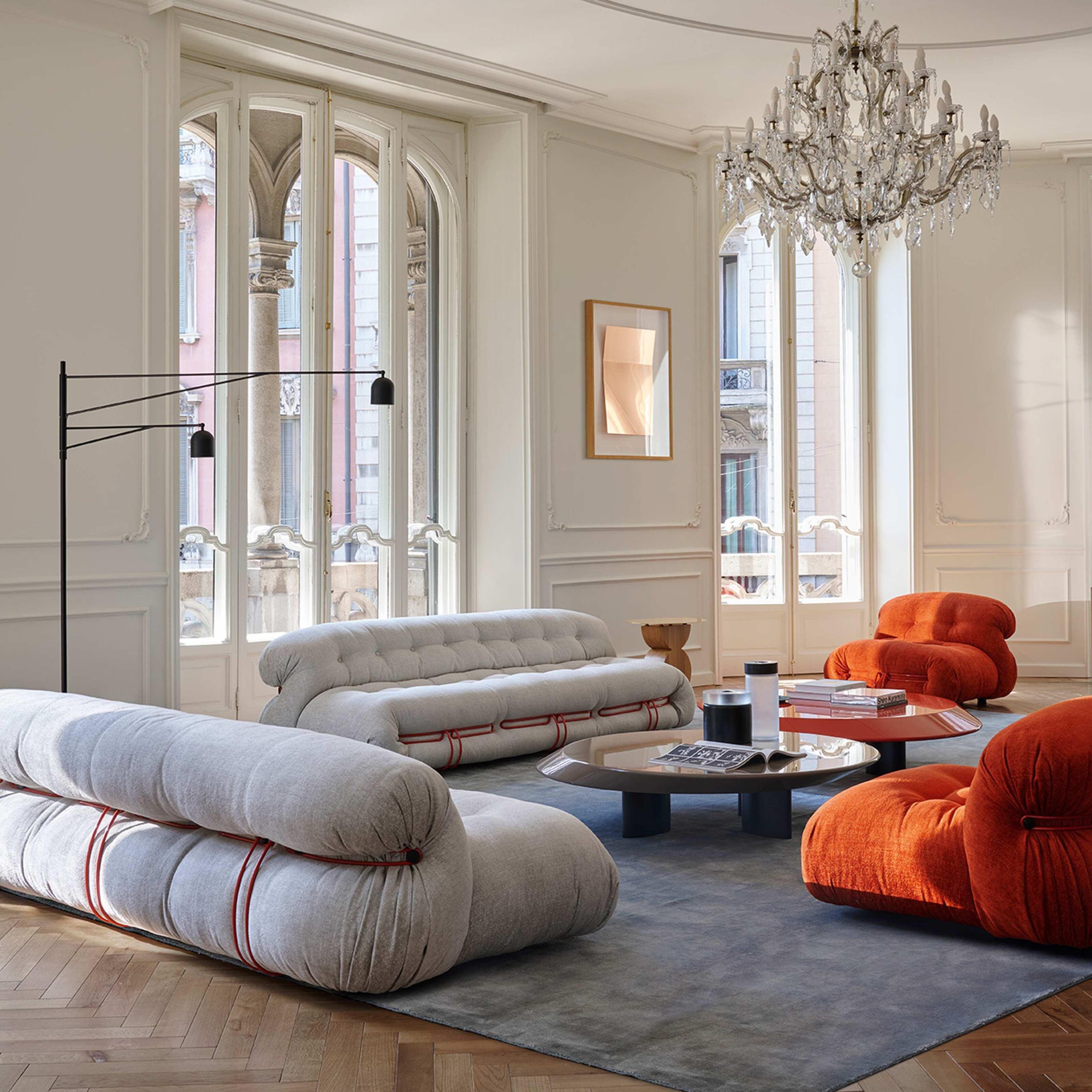
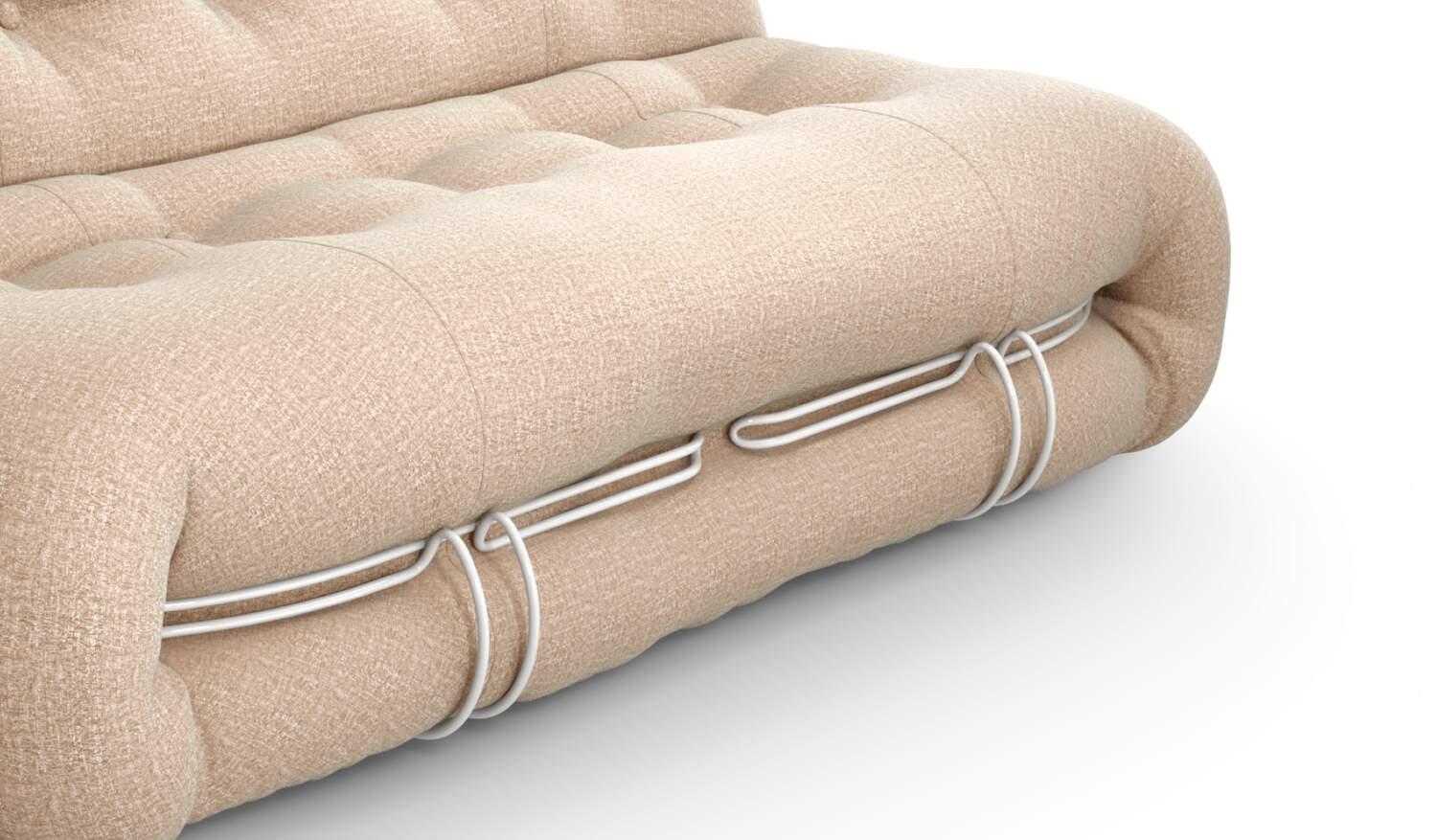
At first glance, Soriana looks as if the upholstery has slipped and someone caught it just before it fell apart. It is soft, swollen, creased, almost overripe. But then there is the metal. A bright clamp wraps around the upholstered mass and holds it in place, like jewellery doing structural work. The sofa seems to be collapsing and being controlled at exactly the same time.
That is the thrill of it.
Soriana does not hide the drama of comfort. It stages it.
The phone call before Cologne
Imagine arriving at the Cologne furniture fair in January 1970. The postwar modernist room is still full of discipline: clean lines, rational frames, timber, steel, the furniture of order. But something has changed. The late 1960s have already loosened the edges.
The Sacco beanbag has arrived from Zanotta in 1968, a pear-shaped sack that lets the body decide its own chair. Gaetano Pesce’s Up series has appeared in 1969, all swollen forms and symbolic tension. Italian radical design is making furniture stranger, softer, more political, more bodily. Within the next year, De Pas, D’Urbino and Lomazzi will release the Joe chair, a giant baseball glove with the confidence of a joke that knows it is serious. Mario Bellini’s Camaleonda will turn the sofa into a padded system of squares. A few years later, Michel Ducaroy’s Togo will sink the living room almost to the floor.
The room is changing fast.
But Soriana is not quite like any of them.
It is not formless like Sacco. It is not pop theatre like Joe. It is not modular landscape like Camaleonda. It is not floor-level surrender like Togo. Soriana is a softer kind of argument: upholstery as an event.
The Scarpas took the material of the moment, expanding polyurethane, and pushed it away from neatness. This was not foam pretending to be traditional upholstery. It was foam being allowed to swell, crease and behave like a new material. The cover was not meant to be pulled tight like a well-behaved suit. It was meant to look loose, soft, gathered, almost improvised.
That detail mattered enough that even the workers reportedly misunderstood it at first. The covering was not supposed to look taut. It was supposed to look like a soft skin curled around a mass and held by a giant metal spring.
This is where Soriana becomes more than a sofa.
It is a disagreement with tailoring.
The Scarpas were not careless people
This is the delicious contradiction. Soriana looks casual, but Afra and Tobia Scarpa were not casual designers.
Tobia Scarpa was the son of Carlo Scarpa, one of the great Venetian architects of detail, material, junction and restraint. Afra and Tobia trained as architects and worked across furniture, lighting, interiors, industrial buildings and objects. Their best work often has this tension between craft and industry, softness and precision, old-world material intelligence and modern production.
They were not simply making blobs.
That matters because Soriana can be misunderstood as a sofa that gave up. A lumpy luxury object. A beanbag with a metal belt. A plush thing for people who want their living room to look expensive and slightly undone.
But the Scarpas’ work was too intelligent for that. Soriana is not careless. It is composed to look as if care has become relaxed. The shape gives you softness, then the metal clamp corrects it. The foam wants to expand, the chrome wants to contain. The cover wants to wrinkle, the structure insists on silhouette.
It is the furniture version of someone wearing an immaculate coat slightly open in the wind.
And that is why the sofa still feels alive. It catches a moment when modern design stopped trying to look so morally clean. Earlier modernism often wanted to prove its intelligence through reduction. Soriana proves its intelligence through tension. It says: comfort can be messy, but mess needs form.
The metal is the punchline
The most important part of Soriana is not only the softness. It is the thing that interrupts the softness.
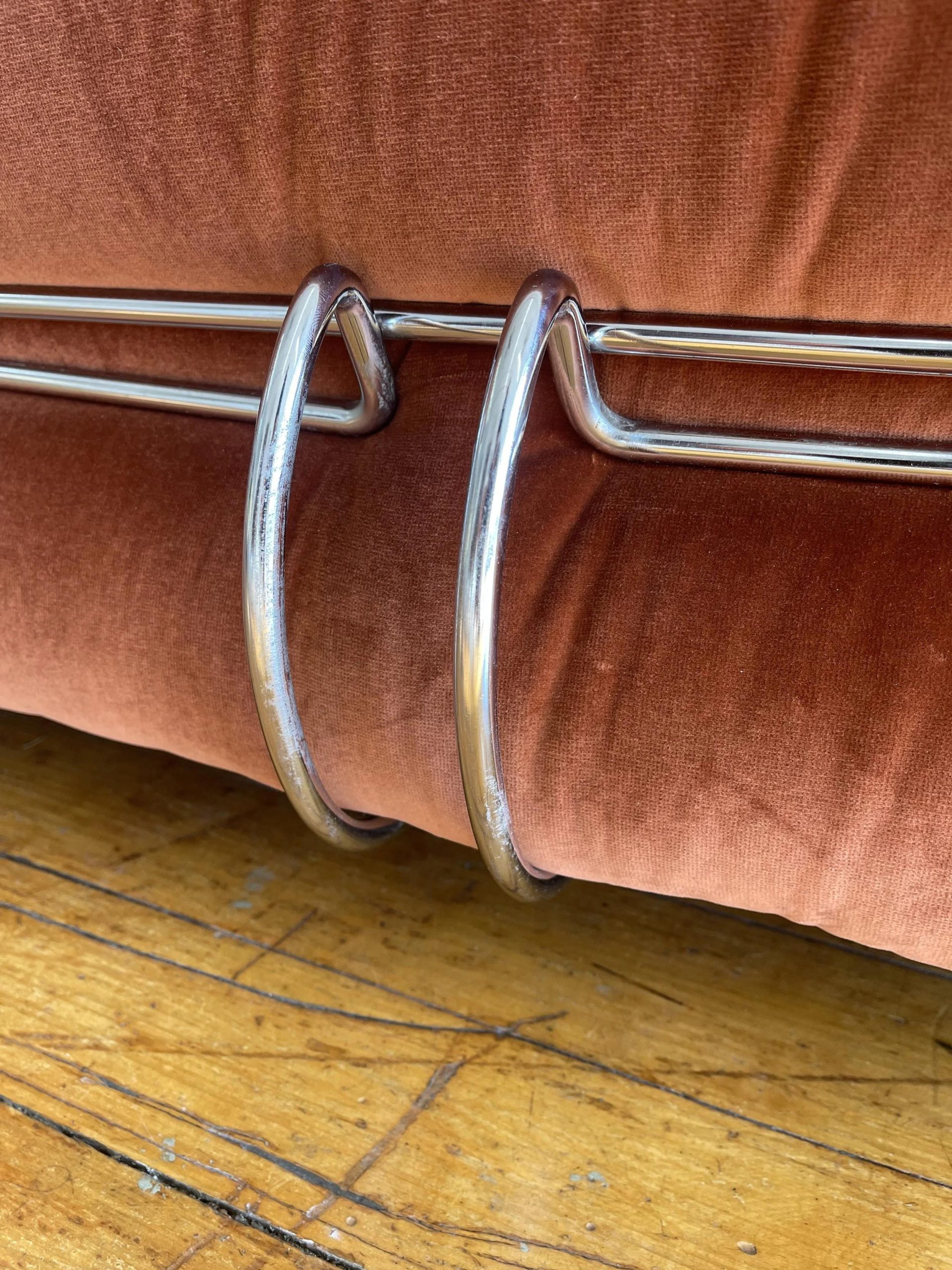
That chrome-plated metal clamp is everything.
Without it, Soriana risks becoming merely shapeless. With it, the sofa gets its character. The clamp gives the eye a hard line to read against the swollen upholstery. It turns the softness into something held, not accidental. It also makes the object feel slightly engineered, as if the sofa has been caught under pressure and strapped into elegance.
This is where copies often fail.
A bad Soriana-style sofa usually understands the puff but not the hold. It gives you a rounded cushion, a creased cover, maybe a shiny strip of metal, but the relationship between the upholstery and the clamp is wrong. The metal becomes decoration rather than tension. The fabric looks wrinkled because it has been poorly cut, not because it is deliberately gathered around a soft internal form. The foam either sits too dead or rises too cartoonishly. The sofa starts to look like a costume of Soriana, not Soriana itself.
The original idea is more specific. The upholstery is meant to look loose, but not lazy. The mass is meant to look generous, but not sloppy. The clamp is meant to look like it is doing work, even when part of its power is theatrical.
That is the difference between a sofa that looks expensive because it is shiny and one that looks expensive because every contradiction has been resolved.
A cheap copy gives you the crease.
“Soriana gives you the crease, the pressure, and the release.”
A sofa for a country under pressure
The strange thing about Soriana is how perfectly it suits the Italy around it.
This was a country of extraordinary design confidence and intense social strain. Factories were producing the future, but the people inside those factories were demanding a different deal. Italian companies were becoming masters of industrial materials, while politics was becoming unstable and sometimes frightening. The domestic interior, that supposedly private refuge, could not help absorbing the mood.
Soriana looks like that moment.
It is industrial and bodily. Luxurious and stressed. Soft, but clamped. Comfortable, but not innocent. It does not have the clean optimism of earlier modernist furniture. It has a more complicated glamour.
That is why I like it. It does not pretend comfort is pure. It admits that comfort can be dramatic. It admits that the body wants softness, but the eye still wants structure. It understands that a living room is not only a place of rest. It is also a stage for taste, status, fatigue, family, money, desire and whatever the decade has done to everyone before they got home.
Soriana won the Compasso d’Oro in 1970, and it deserved the prize because it turned a technical experiment into an emotional object. The jury was not simply rewarding a soft sofa. It was recognising a new way to make softness legible.
The sofa does not say, “I am comfortable.”
It says, “look what comfort is doing.”
Falling out, coming back
Like many objects that belong too perfectly to their moment, Soriana eventually fell out of favour. Cassina ended production in the early 1980s. The decade had changed. The soft, louche, low-slung mood of the 1970s began to look dated to people who wanted cleaner lines, sharper wealth, different signals.
Then time did what time always does to brave design. It made the once-strange object desirable again.
Soriana returned through collectors, designers and interiors that were tired of minimalism’s straight face. Vintage examples began to look less like leftovers from the 1970s and more like evidence of a lost confidence: a time when designers were willing to make furniture that looked tactile, swollen, almost edible, without apologising for it.
By the time the design was reissued, the world had changed again. Sustainability had become part of the conversation. The very foam technologies that once felt like the future now raised environmental questions. Cassina’s updated Soriana responded with newer internal materials, including BioFoam, while preserving the old visual argument: a soft mass, visibly held.
That is a good metaphor for the revival. The outside says memory. The inside has to answer the present.
And this is why Soriana feels so current now. We have had enough of rooms that look over-controlled. Enough interiors where every object is polite, beige and terrified of being strange. Soriana brings back a kind of luxurious imperfection. It lets the room breathe, slump and perform. It gives softness a little drama.
The beauty of almost falling apart
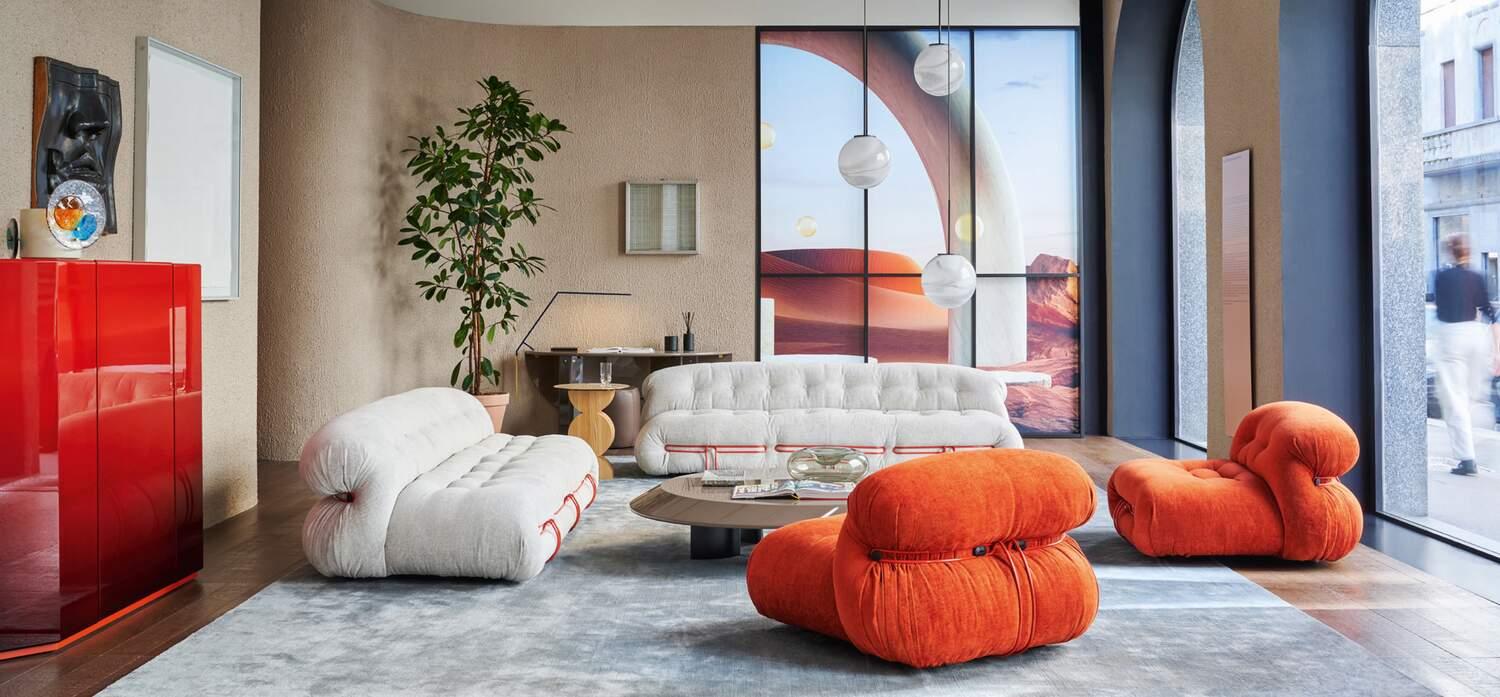
The best thing about Soriana is that it never looks fully settled.
Togo sits low and invites you to surrender. Camaleonda asks you to rearrange the room. Maralunga will later give comfort an adjustable collar. Soriana does something more theatrical. It shows the moment before form becomes disorder, then holds it there.
That is why it is still worth writing about.
It is not simply a sofa. It is a captured gesture.
A cover curls around foam. Metal grips the body. The surface wrinkles. The seat swells. The whole thing looks as if it might come undone, but never does. That tension is more interesting than perfection.
To see Soriana in person, properly, is to feel the room become less polite. It does not shout, but it does make the other furniture look a little over-rehearsed. A normal sofa sits there performing good behaviour. Soriana looks as if it has already had the evening, loosened its clothes, and still somehow remained the most elegant person in the room.
You do not admire it because it is tidy.
You admire it because it knows exactly how untidy to be.
A Loom & Hide design-archive story. We write about these pieces for the love of the ideas; we do not make replicas or copies of protected original designs.

