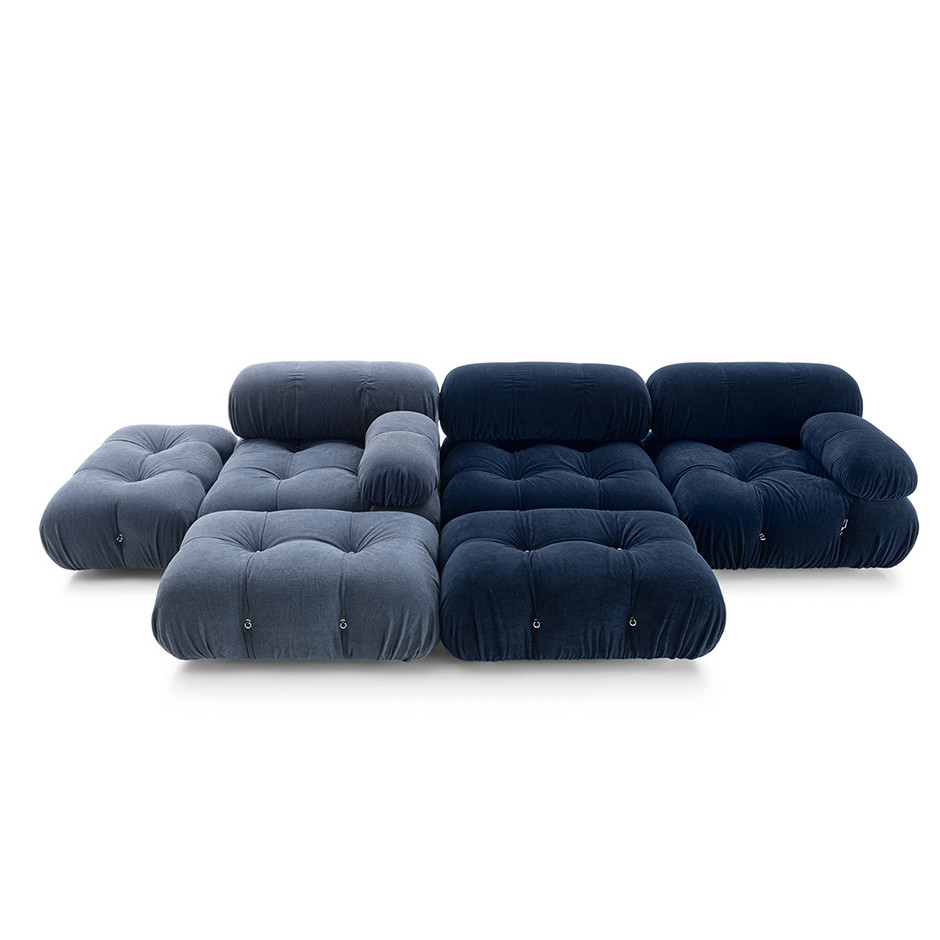
In 1970 the living room stopped believing in staying still. Mario Bellini built a sofa out of pieces and handed the room permission to change the plan.
It is 1970, and the room no longer believes in staying still.
Outside, the decade has opened badly and brilliantly. Apollo 13 has gone up toward the Moon and nearly not come back. The first Boeing 747 has entered service, making the sky feel suddenly larger and more crowded. The first Earth Day has announced that the future is not only technological, but ecological. The Beatles have broken up, which means even the sound of the previous decade has lost its centre.
In Italy, things are more tense than glamorous. The Hot Autumn of 1969 has spilled into the new decade: factories, students, unions, strikes, demands, police lines, the industrial north arguing with itself in public. The Years of Lead are beginning to form in the background. In December, Italy will legalise divorce, a legal change that makes the private home feel political in a new way. Even family life, that supposedly fixed unit around which the living room was built, is no longer quite as fixed as it pretended to be.
And then Mario Bellini designs a sofa made of pieces. Not a sofa as one obedient object. Not a three-seater with a left arm, a right arm and a middle seat waiting for guests to behave. Not a formal island placed opposite a coffee table as if the living room were a small parliament. The Camaleonda is a sofa that can be rearranged.
“Permission to change the plan.”
That sounds normal now because half the world has become modular. Our calendars, kitchens, phones, feeds, workdays and homes are all editable. But in 1970, this was not just a furniture feature. It was a worldview. A sofa that could become an armchair, a daybed, a sectional, an island, a sprawl, a conversation pit, a soft barricade, a room inside the room, was not a sofa simply offering comfort. It was a sofa offering permission.
Italy was already rearranging itself
- 1968. The Sacco beanbag arrives as a sack that only becomes a chair once a body collapses into it.
- 1969. Gaetano Pesce’s Up series swells out of compression; Afra and Tobia Scarpa’s Soriana makes upholstery look squeezed and held by metal tension.
- 1970. De Pas, D’Urbino and Lomazzi produce the Joe chair, a giant baseball glove. Bellini answers with the Camaleonda.
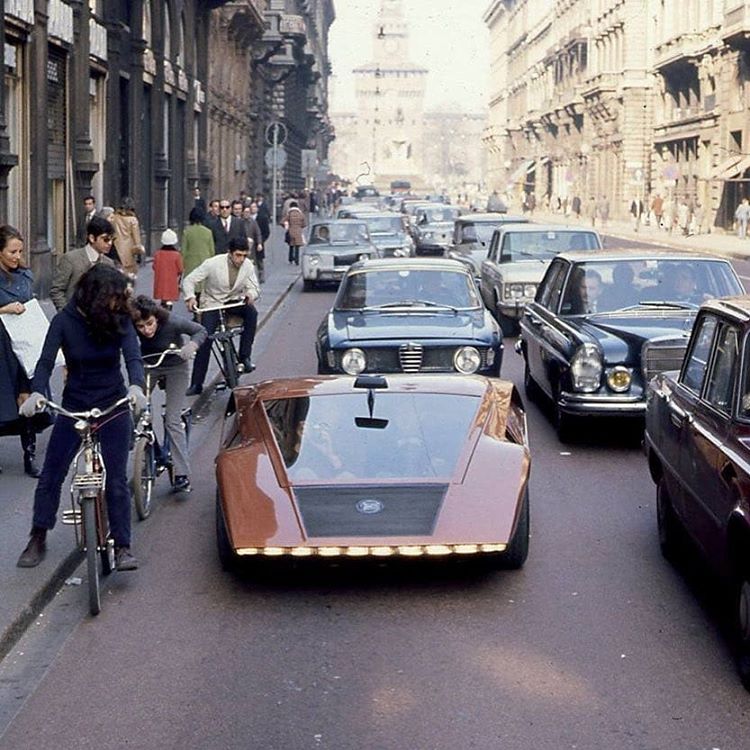
To understand the Camaleonda, you have to forget the polite showroom version for a moment and return to an Italy that was restless, inventive and fraying at the edges. Italian design at the end of the 1960s was not quietly choosing fabrics. It was arguing. Radical design was pushing against bourgeois domestic life. Plastic, foam, inflatables, pop objects and anti-furniture were entering the conversation. Then there was Pierre Paulin in France, making chairs that seemed to have been pulled over their frames like clothing over a body.
So the Camaleonda did not arrive into a calm field. It entered a fight about what furniture was allowed to be. Bellini saw the problem clearly. The sofa market, as he later described it, seemed stuck between two unsatisfying poles: old typologies dressed in new clothes, or radical futuristic gestures too elitist to answer ordinary changing lives. Camaleonda took the third route. It was strange, yes, but not alien. It was luxurious, but not stiff. It was system furniture that still looked like something you could roll into after dinner.
That is its genius. It does not ask the home to become a spaceship. It asks the home to become more alive.
The first time you see the squares
I imagine seeing it first not as a thumbnail, not as a celebrity living-room clue on a phone screen, but as a real object in the early 1970s, perhaps in Milan, perhaps in a trade stand, perhaps later in New York at MoMA’s Italy: The New Domestic Landscape, where Italian design was shown not as decoration but as a new domestic proposition.
You walk in expecting furniture and find a padded field. At first the eye does not read it as a sofa. It reads it as units. Big soft squares. Tufted blocks. A grid that has somehow gone lazy. It looks mathematical and overfed at the same time. The surface is puffy, but the logic is strict. There are seats, backs and arms, but none of them seems permanently sentenced to a single role. That first confusion is the point. Most sofas tell you how to use them before you sit. The Camaleonda asks a question first: what kind of room are we making today?
“A formal sofa is a sentence. Camaleonda is a grammar.”
You can make it face one direction or several. You can make it social, private, wide, compact, broken into islands, pushed into a corner, opened into a field. It is not only something to sit on. It is a way to edit the room. This is why the name matters. Camaleonda combines camaleonte, the chameleon, and onda, the wave. Adaptation and movement. The sofa changes with the environment, but it also changes the environment back. Like a wave, it alters the edge of the room.
A beautiful trick with hardware inside it
The Camaleonda’s softness is seductive, but the real intelligence is mechanical. B&B Italia’s current description of the design points back to the system Bellini created in 1970: modules joined through cables, hooks and rings, with tie-rods and carabiners allowing the units to be unhooked and recombined. That is the part a photograph cannot fully explain. The sofa is not just a soft shape. It is a soft shape with a linking system. This is what makes it different from a pile of cushions.
The capitonné surface gives each module its recognisable topography. The squares look swollen, like padded pixels. The low height keeps the body close to the floor without making the sofa feel collapsed. The modules have enough geometry to stop the softness becoming mush. It is a landscape, but it is not a swamp. The reissued version preserves the 90 x 90 cm seat module, the backrest, armrest and characteristic surface language, while updating the internal structure with recycled or recyclable materials and layered polyurethane of varying density and firmness.
A bad Camaleonda-style sofa gives you fat squares and nothing else. It looks right for ten seconds, then the body starts asking questions. Are the modules actually locked together, or just pushed beside each other? Does the back support, or is it a pillow wearing a serious expression? Does the foam recover? The fake version understands the grid but not the choreography. The real design is modular because the sections keep their identity while becoming something larger together. That is much harder to copy than a puffy square.
The sofa as social technology
What makes Camaleonda feel important is not that it is big or comfortable or collectible. It is that it treats the living room as a changing social system. A normal sofa assumes a relatively stable situation. Three people sit this way. Two armchairs sit opposite. A coffee table mediates. The room has a script. Camaleonda breaks the script. It can make people face each other, or not. It can create corners where no wall exists. It can turn a single room into zones without building anything.
This is why it belongs so deeply to the 1970s. The decade was obsessed with environments: mobile environments, inflatable environments, conversation pits, modular systems, adaptable interiors. Bellini himself would go on to design the Kar-a-Sutra mobile environment for MoMA’s 1972 exhibition, a project that imagined the car not only as transport but as a living system. Camaleonda has that same intelligence in domestic form. It is less interested in the sofa as object than in the sofa as situation. Comfort is how the cushion feels. Behaviour is what the object makes people do. Camaleonda makes people gather differently.
Disappearing, returning, becoming a trophy
The Camaleonda was produced through the 1970s and later became a collector’s object, made more desirable by absence. Production stopped in 1979, which gave the sofa the kind of afterlife that design dealers understand very well: scarcity, provenance, patina, obsession. Then the internet found it. Camaleonda photographs like a symbol: soft squares, low mass, Italian glamour, expensive informality. It became the kind of piece people recognised before they knew its name.
By the time B&B Italia reintroduced it in 2020, the world had again become obsessed with flexibility. Homes were offices, classrooms, gyms, lounges, restaurants, photo studios, therapy rooms and hiding places. The revival did not feel accidental. Like the 1970s, the early 2020s asked rooms to do too much. But there is irony here too. A sofa designed to resist fixed form became one of the most fixed status images of contemporary interiors. You know the photograph: pale bouclé or leather, art books, low table, plaster wall, expensive casualness. The piece that once made the room move became, in some homes, a trophy of having the right kind of taste.
That does not ruin it. It just proves how dangerous icons are. They begin as questions and end as answers people buy. The best Camaleonda rooms still keep the question alive. They do not treat it as a precious object. They let it shift. They let modules move, people sprawl, children climb, guests rearrange the evening. The sofa only makes sense when it is allowed to behave like a system rather than a monument.
The room does not have to obey
The Camaleonda’s impact is not that it invented modular seating. It did not. Its impact is that it made modular seating feel emotionally desirable. It took the logic of systems and softened it. It took geometry and made it bodily. It took the changing social life of the home and gave it a furniture form. That is why it still matters. Not because every living room needs one, but because it captures a permanent domestic truth: rooms change because people change.
The Camaleonda survives because it understands that contradiction. It can look glamorous and still invite disorder. It can be collectible and still useful. It can be a grid and a wave. It can be a design icon and a domestic animal. It can make a room feel planned, then let the plan fall apart beautifully. To see it properly is to feel the room become less obedient. That is the real seduction. Not the puffiness. Not the price. The seduction is the possibility that the sofa is not finished deciding what it is. And maybe neither are you.
A Loom & Hide design-archive story. We write about these pieces for the love of the ideas; we do not make replicas or copies of protected original designs.
- B&B Italia, Camaleonda (modular system, 90 x 90 cm module, 2020 reissue).
- Architectural Digest on the 2020 reissue.
- MoMA, Italy: The New Domestic Landscape.
Sit lower. Sit longer.
Loom & Hide builds handcrafted sofas in Woodstock, Cape Town, for people who want a room that can change with them.

